Tuesday, June 22, 2010

The Beard Saves Pool

How to fix pool? That was the theme of this month's Pool Synergy project. I posed the question to Hall of Fame player Nick Varner, whom I featured in my essay. You can read it here.  But Nick's wasn't the last word on the topic. I also received emailed and Facebook suggestions from several other people, all of whom offered great ideas.  And I spoke for a few minutes with my friend Freddy "The Beard" Bentivegna, author of Banking with the Beard and The GosPool of Bank Pool.

For those unfamiliar with The Beard, he is one funny guy. The Beard is the teller of many great road stories, some of which you can read at his website, others you can read in his books (that you can find here), and some you can read at this separate Q&A at One-pocket.org. I teed up a few questions the other day about fixing pool, and he knocked 'em down. I've included a partial transcript of our conversation below. 

Q. What about deep pocketed promoters? Does pool need another Kevin Trudeau, or was he bad for the sport?

The Beard: Everybody attacked Trudeau. But the (pool world) never had tournaments like that.  Ever. They never had that kind of class. I went to a couple of ... the match games. He had Earl (Strickland) play Johnny Archer. ... They fu***d up the television, then ran it on the Internet. But it was a fabulous high-class deal, and everybody had a great time. It was done really, really well. There are so many knockers of Trudeau in the (Internet) forums but everybody ended up getting paid. Ninety-eight percent of the money ended getting paid off.

Q. So why didn't it work?

The Beard: They caught a bad break. When they changed the law where you couldn’t have Internet gambling — that was the whole deal. Trudeau was selling (the tour) to a billionaire from Shanghai and at the same time, the government passed the law — no more Internet gambling. They wanted to be able to bet on the pool games. When they removed that option, he (the billionaire) lost interest.

Q. Speaking of promoters — does pool need another Minnesota Fats?

The Beard:  Yes, pool doesn't have a character right now and we need another character. ... You've got to have somebody who's interesting. ... So you need someone with a personality, and the key is also that you have some money, so people show up to watch. ... Look at how poker took off with all those characters like Amarillo Slim. Those characters are what made the game.

Q. Does gambling help?

The Beard:  You got 500 guys enter (at Derby City) and that’s successful. People stay around for 10 days. That's an exciting tournament. Everybody loves it. Gambling is what makes it. 24 hours, until three or four in the morning, you can't get a table. They're all going.

Q. What else?

The Beard: I got some ideas.  We had this idea for Quantum 8-ball, which is where you play 8 ball with nine balls. (The Beard goes on to explain the rules for the handicap game. I'll provide further explanation in a separate post.) There's not going to be interest in playing ... if there is too much disparity between Mickey the Mope and Bustamante.

Check back soon for more description of the Beard's handicap games, plus more suggestions from other readers about fixing pool. I've also got a few of The Beard's autographed books available.  Go here for more details.

-- R.A. Dyer

Wednesday, June 16, 2010

Judge Roy Bean was a Brunswick Man


These are pictures of the the famous Jersey Lily Saloon, located in Langtry, Texas. One was taken in the early 1900s, the other taken during a family outing about six weeks ago. This place is so remote, even the tumble weeds have tumble weeds. Nothing but desert, mountains, cactus and dirt. The Jersey Lily is pretty much all that's left of this west Texas ghost town. That, and the Texas Parks & Wildlife tourist center marking the site.

The Jersey Lily is the famous court house and saloon where none other than Judge Roy Bean held forth. For those unfamiliar with cowboy lore, Roy Bean was the somewhat larger-than-life "Law West of The Pecos." He was a businessman, showman, and famous teller of tall tales. In that regard he reminds me somewhat of our own Minnesota Fats.

And that brings us to the subject of pool. What does an Old West figure, a man made famous in a Paul Newman film and TV shows, have to do with our fair sport? Well, as it turns out, Bean had a table in his saloon. The table wasn't portrayed in the famous John Huston movie, but the table was there nonetheless. That's a picture of me with what's left of it — the iron legs — inside the old Jersey Lily.

I'm told by folks smarter than myself that these are legs associated with a Brunswick Monarch, which has been described as the "King of Pool Tables." One knowledgeable person tells me that the tables, when restored, can fetch upwards of $100,000. Monarchs of varying styles were apparently manufactured by Brunswick between 1845 and 1875.

I went online and found a couple of websites devoted to the Brunswick Monarch. The image just above is taken from a website maintained by John Sears, who restores vintage tables. The similarity of the legs to those in Langtry is unmistakable. Sears has bought and sold several Monarchs over the years and tells me that the restored table featured in the photo just above went for $165,000. You can see more photos of restored Brunswick Monarchs here.

-- R.A. Dyer

Tuesday, June 15, 2010

Pool Synergy 8: How To Fix Pool

This month's PoolSynergy topic is "How to Fix Pool." Consider that our sport's top money winners would rank dismally low if they were playing golf of tennis, that TV coverage is rotten and that the tours are either non-existent or in disarray. So what to do about it?  We've got a number of excellent contributions this month.

About Pool Synergy
But first, a quick review. Pool Synergy is an online collaborative effort of pool bloggers, each of whom agrees to write about the same topic on the 15th of each month. This is the project's 10th edition. Previous Pool Synergies have covered playing tips, historic players and controversial issues such as gambling.  The topics are selected by the Pool Synergy host, a position that rotates each month. (This month, it's me.)  If you want to participate, contact John Biddle at the poolstudent.com,  or whoever happens to be the host that month. Also, feel free to opine on your own blog or Facebook page about a Pool Synergy topic. Anyone with an opinion should weigh in.  The idea is to get a general conversation going about issues important to our sport. And spread the word! Press the share button, or post a note on your own page.  

The Contributors
And now on to the essays. First up is one entitled "A Modest Proposal," from new contributor Maximus Snarkinous. Maxiumus (not his real name) is the sometimes controversial author of the Pool Cue News & Review blog. "The professional pool player cannot eek out a livable wage," he writes. "Billiards establishments are closing their doors throughout the country. Change is imperative." Go to his blog to read more. You can find his essay here.

Mark Finkelstein, a contributor with nycgrind.com, says pool needs is a face lift. "The 'problem' with pool is that no corporate sponsor that I know would want to fund a player called 'Kill 'em Dead Kid' wearing a backward baseball hat and playing cheap sets with a sucker," he writes. You can check out his full essay here.

Melinda, the author of the Pool Is A Journey blog, responds in a completely different way. She argues that our sport is not really in that bad of shape. "When I first read the topic my immediate reaction was, 'pool is broken? 'I can be an annoyingly optimistic person at times, though, and I completely admit that, so maybe that is why I have this attitude, what is there to fix?" Get Melinda's take on the question here.

The author of the p00lriah blog has a two-pronged approach for fixing pool. He calls it the "Texas Two-Step." But to learn the dance steps, you'll have to check out p00lriah's blog. You can find his essay here.
John Biddle, founder of the Pool Synergy project, believes that there's not much that can be done at the fan or player level. In order to fix pool, the promoters need to step up.  "As in all other successful (as a business) professional sports, the businessmen are the team/league owners and the players are just well paid employees," writes Biddle. His essay, entitled "Fixing Pool — An Outsider's View," can be found here.


Samm "Cherry Bomb" Diep takes the long view. She notes that The Hustler and The Color Of Money, two great pool movies, both sparked revivals. Now, 25 years later, is it time for another great pool movie? You can read Samm's essay at pooltipjar.com, her pool blog. Here's the link.

Gail Glazebrook, the 2010 BCAPL Women's Open National Champion and the woman behind the "Confessions of G Squared" blog,  writes that the environment, image and presentation of pool has to change. She also discusses the impact of her ongoing web series that follows her pool team, Kiss of Death. "Highlighting the personalities, blood, sweat, tears and DRAMA of pool.  ... We just have to put it on the menu," writes Glazebrook. Check out her essay here.

Billiard Coach Mike Fieldhammer offers us a three-step method: improving playing conditions, pool eduction and professionally run tournaments.  Fieldhammer is the man behind billiardcoach.com. He says he's been doing all he can to stop the downward spiral of pool. You can find his essay here.

Michael Reddick, the man behind the Angle of Reflection blog, notes that billiards is arguably the largest participation sport in America — bigger even than football or even baseball in that regard.  And yet pool players earn much less than players for other sports. "How do we change the billiard industry to increase revenues and support larger payouts (or salaries) for the upper echelon players?" asks Michael. You can read the rest here.


 As for me?  I posed the "How to Fix Pool" question to Hall of Famer Nick Varner, as well as Freddy "The Beard" Bentivegna. In the last several weeks others also have posted up great suggestions about fixing pool on my Pool History Facebook page, or have sent me emails. My essay this month focuses primarily on Varner's comments, but I'll be sure to loop back soon and write about many of the other suggestions I've received. You can find my essay here.

-- R.A. Dyer

Pool Synergy 8: Mika, Tiger and Nick Varner

Mika Immonen's prize earnings last year totaled $238,320 — admittedly a pretty good haul for pool. That made The Iceman pool's top money winner for 2009. Also that year another athlete by the name of Tiger Woods won $10.5 million. Actually, the precise figure was $10,508,163. Getting out my calculator, I find that golf's top player won 44 times more than pool's top player. And of course this doesn't figure in all the money Tiger made from his product endorsements. If you add that cash, the gap would be much wider.

The money difference between golf's No. 1 and pool's No. 1 may not be all that shocking given what we all know about Tiger Woods. He is, after all, the most well-paid sports figure on the planet. But if one continues looking down the PGA's money list — and I'm talking about very far down —you come to a man named  Jose Maria Olazabal. Olazabel is ranked 185th on the golf tour. Given his standing, it's likely that many of you may never have heard of Mr. Olazabel.  But even this no-name golfer, a man ranked a measly 185th — even this guy made away with more money than our No. 1.


Similar comparisons can be made with tennis players, poker players — hell, even bowlers sometimes make more money than pool players. This, in a word, is pathetic. Something definitely is not right with our sport.  But is this lack of money a symptom of pool's malaise or a cause? And what can be done to fix it?

Welcome back to Pool Synergy, the monthly online forum on our sport's most pressing questions.  This month's topic: "How to Fix Pool." We have fine contributions for our latest edition from John Biddle, Mike Fieldhammer, Samm Diep, p00lriah, Gail Glazebrook, Mark Finkelstein, Pool is a Journey blogger Melinda, Michael Reddick, and the snarky Pool Cue News & Review guy. As I'm this month's host, I've also created a separate page summarizing all the great essays and showing where you can find links to them.


Dancing With The Stars?
The ideas for fixing pool have been flooding in ever since I announced this month's topic. Folks have suggested everything from Dancing With The Stars TV programming to a new video game. I've also interviewed a few pool experts, including my friend Freddy "The Beard" Bentivegna, the author of several popular instructional books. I'll continue to post up all those suggestions in the days to come. But for today's essay, I turn to none other than Nick Varner, the eight-time world champion and Hall of Fame inductee. Nick is one of the most easy going guys you're likely to meet. But you can sense the frustration just below the surface when you ask him about the state of American pocket billiards.

The Almighty Dollar
"Our economy is driven by the almighty dollar, whether you like it or not. You think anybody would be watching Tiger Woods if he was playing in the local golf club for $1,500? No way."  Nick, a Kentucky resident, speaks with a syrupy drawl. He's been watching pool and playing it for years. And as the owner of his cue company, he has a stake in getting our sport back on track.

"Folks don't see a future for this game, except from a hobby standpoint," he says. "There's no way to make living. The best players in the world, they're struggling — and it's a shame. ... So there's no reason for a young kid to aspire to become the best in the world. Nothing is going to change the image of the sport, except big prize money."

And, so what's the key to bringing more money to the sport? Varner has a few suggestions. First, obviously, a deep-pocketed promoter always helps. But Varner also suggests, perhaps somewhat controversially, that fans should have an ability to gamble on matches. "If you could bet on pool matches, I think that would be phenomenal," he says. "That would create a lot of interest. People that knock gambling need to take a strong look at poker."

Another interesting idea from Varner, and one that I haven't heard discussed much, is for more team play — but with teams from distinct geographical areas. Imagine a domestic tour, but with groups of players representing individual American cities or states. In the Mosconi Cup, it's the U.S. versus England. With Varner's idea, it would be Texas versus New York, or Los Angeles versus Cleveland.

Varner calls the Mosconi Cup one of pool's most exciting events. He has participated both as a player and as the U.S. team captain.  "That's what we need," he said. "To really make this game (successful) we need to figure out how it could be economically feasible to have teams like in the NBA or the NFL. We could have state teams. This creates a geographic fan base. Right now there isn't a whole lot of team stuff going on. But with a Georgia team versus Florida, say, that automatically hits us like a college sport. This (attracts) the sports fan."

Nick, a two-time national colleagiate champion,  says more support from universities also could help. After all, it was his participation in tournaments sponsored by the Association of College Unions International that started Varner on his tournament career.  He said the ACUI tournaments have been around since 1940s, but in recent years universities seem to have moved away from pool. "A lot of universities are going a little different way these days," he explains. "The emphasis back before was on lifetime sports — bowling and billiards, things you can participate in for all your years. But now health fitness is getting a lot bigger. A lot of universities have made their game rooms a lot smaller."

So, these are Varner's ideas in a nutshell:

1. Thumbs up to organized gambling on pool
2. Regional teams
3. Support at the university level

Check back here in the coming days for Freddy "The Beard" Bentivegna's suggestions, as well as suggestions from other pool fans. Also don't miss the other Pool Synergy submissions this month. Have your own ideas? Feel free to comment here, or at the Pool & Billiard History Facebook page.


-- R.A. Dyer

Thursday, June 3, 2010

Upcoming PoolSynergy: How to Fix Pool?

I'm the host for this month's PoolSynergy project, which goes live on July 15th.   If you're not familiar with PoolSynergy, you can poke through this blog to find some of my recent contributions. They're typically marked with the PoolSynergy logo, displayed just below. Or you can click here to read one of my recent contributions about pool and folklore.

PoolSynergy was founded by John Biddle, the man behind The Pool Student's Blog.  This is is how it works: each month online writers with an interest in pool and billiards agree to write about a common theme and then post their contributions on the 15th.  There's a different host for PoolSynergy each month.  (This month it's me.) It is the host's responsibility to post links and descriptions for a selection of the essays on his or her own website or blog. However, you don't have to submit essays to the host to participate. Just write about the theme on your own blog or Facebook page. The idea is to get a general conversation going about issues important to the billiards community. If you want to participate in a more formal way, shoot me an email or contact John Biddle at the pool student's blog.

This Month's Topic

This month's PoolSynergy topic is "How to Fix Pool." Consider that our sport's top money winners would probably rank around 150th if they were playing golf, the TV coverage is spotty and the tours are either non-existent or in disarray. So what to do about it? If you have a good idea about this topic (or even a bad one) post it up on your blog or Facebook page on June 15th. You can also post up comments here or on my pool history Facebook page, which you can find here.

And tell a friend. Press the share button on your Facebook page, or get the word out to your pool buddies on Twitter.

Tuesday, May 18, 2010

New Poll: Those favoring gambling in pool outnumber opponents by more than 3 to 1

But Plurality Say Gambling is a "Mixed Bag"

Is pool's long association with gambling good for the sport or bad? That was the poll question I asked several months ago as part of an earlier essay I contributed to the Pool Synergy project. I had found then that there were strong opinions on the subject, both pro and con.

For instance John Biddle, the Pool Synergy founder, believes gambling is bad for the sport. "Pool has a very active gambling culture that harms the sport and many of its players, limits it audience and turns off potential sponsors," he wrote in an essay, which you can read here.

But Justin Collett, founder of The Action Report, praises the drama of one-on-one action — especially if it features top players. "It really is no secret it is as old as time —people want the drama of a contest," says Mr. Collett.

So what do readers of this blog feel? Acording to my unscientific poll, a bit fewer than half believe that pool's association with gambling is both good AND bad. That is, 53 of the 111 online respondents — or 47 percent — described gambling as a "mixed bag."

However it was the gambling-is-good contingent who prevailed among those who came down forcefully one way or the other. Among the overall respondents, 34 percent said gambling is "great" for the sport. Those who said it was "awful" amounted to just 10 percent.

Looking at the raw numbers, we find that 38 people said gambling is great for the sport, while just 12 said it it's awful. That's a more than 3-1 margin for those who support the sport's association with gambling, as opposed to those who think gambling is awful.

One other note. Almost everyone believes that gambling has some sort of impact. Of all respondents, only 7 percent said gambling has no effect whatsoever on the sport.

-- R.A. Dyer
Wednesday, May 12, 2010

Weight, Speed, Amos and Mike Shamos

Mike Shamos. You got to love him. The respected pool historian gives Billiards Digest readers a bit of insight this month about the etymologies of "weight" and "speed" — two words that at first blush seem to be merely modern slang, but in actuality have long histories. Shamos' observations about "weight" are particularly interesting. As any pool player knows,  "weight" can refer to handicap points given to an inferior opponent to even the odds. In this month's Billiards Digest, in a small item in the Wingshots section, Shamos explains that this definition comes directly from a common handicap in horse racing in which younger horses are required to carry weights to even the odds with older horses.  I never really thought about this before, but it makes perfect sense.

Shamos is a longtime columnist for Billiards Digest and curator of the Billiards Archive, one of the world's largest collections of pool memorabilia and books.  He's also author of The New Illustrated Encyclopedia of Billiards, a must-have for any student of the game. In fact, you can find even more about "weight" in that book, including this gem:
"The term is used ... with great effect in the film The Color of Money. Fast Eddy, played by Paul Newman, is hustled by a chubby character named Amos, played by Forest Whitaker. At the end of the session, when Eddie has lost a considerable sum, Amos asks him, "Do you think I need to lose some weight?" (Meaning: "Maybe you could beat me if I didn't play so well.") The line is an inside joke to pool players, but taken by layman to refer only to Amos' girth."
In this month's Billiards Digest Shamos also penned a great homage to author Robert Byrne on the occasion of his 80th birthday. Bryne is one of pool's most successful authors, having sold more than 400,000 instructional books. He's also a Billiard Congress of America Hall of Fame inductee. You'll have to pick up this month's BD to read the full take-out on Byrne, although you can read my short interview with the author here.

-- R.A. Dyer

Tuesday, May 11, 2010

Alfredo de Oro: One of the Greatest Ever

If you've been following along lately, you know we've had on-gain off-again discussions here about the greatest pool players in American history. Several months ago we conducted a poll on the issue.  Willie Mosconi and Ralph Greenleaf received the most votes, which prompted a run-off. The voting is still open on the question. You can find the ballot on the panel at right.

But throughout this discussion there's been one important player who almost entirely escaped notice. That player is Alfredo de Oro, pictured above. De Oro is largely forgotten these days, probably because his spectacular career occurred before living memory and because his exploits were overshadowed by the very colorful Ralph Greenleaf, who followed close on his heels. But de Oro was among the first inductees into the Billiard Congress Hall of Fame. He also mounted a championship career that would rival that of Greenleaf or any of the other lions.

De Oro played both three-cushion and pocket billiards — and excelled at both. According to his short bio in the BCA's Official Rules and Record Book, de Oro first gained the pocket billiards crown in 1887 and then went on to win it 31 more times. I'll say it again: He won it 31 more times. By contrast, both Greenleaf and Mosconi won the pocket billiard title fewer than 30 times apiece. Not only that, but de Oro also held the three-cushion title ten times between 1908 and 1919. Harold Worst also excelled at both sports, but not with de Oro's dominance.

De Oro was born in Manzanilla, Cuba on April 28, 1863. That's a copy of his passport above. (It's incredible what you can find online.) According to a quick bio I found on Wikipdedia, de Oro's first public appearance as a professional was in the fourth US National Fifteen-ball Championship, held in New York, February, 1887. By my calculation, he would have been 23 years old. He died in 1948, two years before Ralph Greenleaf.
-- R.A. Dyer

Friday, May 7, 2010

Keith McCready, Jay Helfert and Pool Wars

I have to confess that my introduction to Keith McCready came in a movie theater. Touchstone Pictures released The Color of Money in 1986, the year I graduated from college.  I had just moved to Costa Rica and I remember going to see the film with a couple of other expats.  I really enjoyed the smoky rooms, thought Tom Cruise and Paul Newman were dynamite, laughed at Iggy Pop's cameo.

But one of the real revelations for me was McCready. I didn't know anything about professional pool at the time, but I could tell, instinctively, that McCready was the real deal. He looked like a pool player. McCready, in the film, had that vaguely side-arm stroke — not as side-armed as Greenleaf's, but neither like an amateur's. And McCready shot fast. By the end of The Color of Money I found myself rooting for McCready's Grady Season's character over Tom Cruise's Vincent.

My friends and I emerged from the darkness of the theater and immediately went hunting for a pool room. We eventually stumbled upon a place called Center Pool, where I proceeded to luck in a few balls.  I  may even have nerdishly uttered some McCready catch phrases. Oooh, the impossible dream. It keeps getting worse and worse, doesn't it? And it was precisely then that I became hooked on the game.  I remain hooked to this very day.

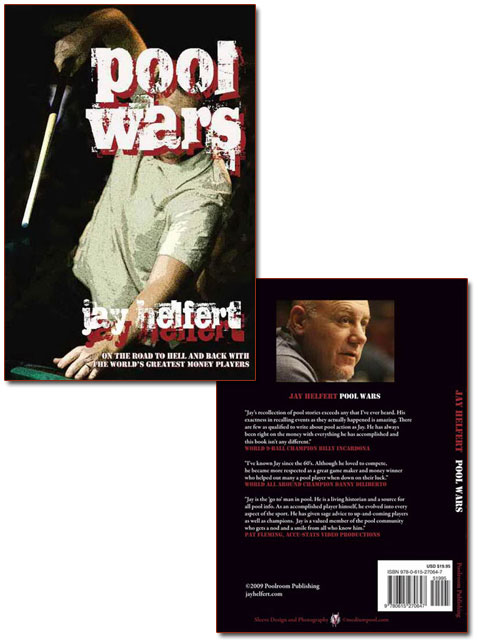
So why this trip down memory lane? Because I just picked up Jay Helfert's great book, Pool Wars. It's subtitled "On the Road to Hell and Back with the World's Greatest Money Players." The subtitle is particularly apt, given that Helfert here has collected stories about Charlie the Ape, Ronnie Allen, Cuban Joe, and of course Minnesota Fats. Helfert writes about brawls and sleeping in pool rooms. He has some wonderful old pictures of a crazy skinny Earl Strickland and Buddy "Rifleman" Hall.

But what got my quick attention was Helfert's recollections of stakehorsing McCready, and Helfert's experience with Martin Scorsese and The Color of Money. The author recalls how Scorsese came out to Barry Behrman's Q-Master billiards to research the film. It was there where the famous movie director discovered McCready as he was going head to head with Danny Medina in a backroom matchup. "They were playing a race to eleven for $1,500 and Keith was in full gear, laughing and joking with all the onlookers," recalled Helfert. "He was both brilliant and hysterical at the same time, and I could tell Scorsese was enthralled by him."

You'll have to get the book to read the rest. But know that McCready, at least very early in his career, was one of the most feared money players in the nation. In that sense he was not so different from his character in The Color of Money. That's what makes those scenes with him so cool. You can tell he's not faking it.

To pick up your copy of Jay Helfert's Pool Wars, check out his website at jayhelfert.com. And if you haven't seen the Color of Money, do so immediately.


-- R.A. Dyer

Sunday, May 2, 2010

Weenie Beenie talks about Cleo Vaughn

 
 Here's an excerpt of an interview I conducted a few years back with Bill "Weenie Beenie" Staton. Some of this, as I recall, ended up in Hustler Days. Staton references in this interview his hot dog stand. That's a picture of the last of his hot dog stands at the top of this post.


Earl Shriver, Squirrel (Marshall Carpenter), Daddy Warbucks – they were all out in Arkansas. Minnesota Fats was there too. It was 1960. And I beat every one of them. I did. Some of them gave me spots, like they used to give me, but I had improved a bit. This was Blytheville, Arkansas.

What attracted them was this guy. Everybody went out there to play him. He was a bookmaker, and he had a lot of money, and he spread it around. He was a winner. I started playing him. He was the one who attracted people there. Daddy Warbucks, Hubert Cokes. Squirrel was there. And Earl Shriver was there. They all congregated there. There was action galore.

I like to say I made over a million dollars. (That’s because) I won $27,000, and I went home and wanted to invest it. I told my lawyer that I won this money, and I wanted to invest it. He said, ‘Bill, you have to declare that on income tax.’ So, I declared it on my income tax, and then built a little hotdog stand. It was 12 foot wide and 20 foot long. It’s still located in Alexandria, Virginia. The way I figure I made $1 million is from the rent I’ve been collecting all these years.


-- R.A. Dyer