Showing posts with label Mike Shamos. Show all posts

Tuesday, August 4, 2015

Pool Historian William Hendricks Dies

Here’s a bit of sad news for pool history fans: William Hendricks, author of the very good but somewhat obscure Official Standard History of Pool, Billiards and Snooker, has died.

The World War II veteran was 90 years old. He passed away on May 15th in an Illinois nursing home.
  
The Official Standard History of Pool, Billiards & Snooker is a hard-to-find gem, one that includes fascinating tidbits about the early history of billiards equipment and the game. A timeline in the book goes all the way back to 1164, and cites the earliest documented use of the word “bille” to refer to certain medieval ball games. 
  
According to an online obituary, Hendricks was born on Sept. 16, 1923 in Alton, Illinois. He served in Europe during World War II and later became a professor at Southwestern Illinois University-Edwardsville and Belleville Area College. He also was an avid pool player.
  
Although never in wide circulation, Hendricks' book has been cited in many other works, including those by billiards historian Mike Shamos (The Illustrated Encyclopedia of Billiards) and John Grissim (Billiards). I also cite Hendricks in The Hustler & The Champ.

-- R.A. Dyer

Wednesday, December 15, 2010

PoolSynergy 14: The Holiday Gift Guide

Put Danny McGoorty in your stocking
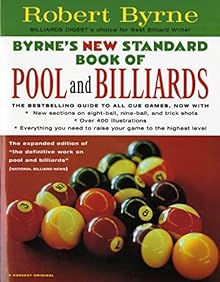
There’s a reason why Robert Byrne is the best-selling author in pool. His books are really, really good. My favorites are his New Standard Book on Pool and Billiards, his Advanced Technique in Pool & Billiards, and his biography of Danny McGoorty.

Our PoolSynergy mission this month was to recommend a single book or video. But this was a task that was beyond me. I simply could not decide. So consider this part of first annual holiday gift-buying guide courtesy PoolSynergy, and the poolhistory.com blog. I recommend several of Bryne books, plus two others from different authors. All pool players should have these on their shelves.


McGoorty, A Pool Room Hustler.
This book is hilarious. Danny McGoorty was a poolroom hustler, ladies’ man, and drunk. Bryne recorded McGoorty’s life's story, and then used it to craft one of the most delightful biographies ever written about an American cueist. This book also includes fun anecdotes about some of the most important players of the last century, including Mosconi, Fats, Cochran and even Alfredo De Oro.

Byrne’s New Standard Book on Pool & Billiards
This is the first instructional book that I ever purchased. Who knew that a collection of table drawings and shot descriptions could be so funny?  A friend of mine had lent me a copy many many years ago. After reading only about 10 pages of it, I marched out and bought my own. You should too. (And while you’re at it, pick up Bryne’s second instructional book Advanced Technique  in Pool & Billiards.)

The New Illustrated Encyclopedia of Billiards.
Ever wonder how many possible ball arrangements there are in a straight-pool rack? Wonder no more. Mike Shamos, in this wonderful collection of the trivial and the historic, tells us. Here, you can learn about Kelly Pool, the Lambert Trophy, and the origin of the slang "weight." There’s plenty of pictures. As a hardback, it makes a perfect addition to any coffee table.


The Hustler
There is no more important novel related to American pool as The Hustler, by Walter  Tevis. Although not based on the life of Rudolf Wanderone, it nonetheless made success of his career. (Wanderone was the hustler who appropriated the Minnesota Fats name). The book also led to the 20th Century Fox movie, which led to a great renaissance for our sport during the 1960s. You also can read all about The Hustler, Minnesota Fats, the 1960s renaissance -- and the interrelation between the the three -- in my own book Hustler Days.

Videos
If you don’t feel like reading, here are a couple of video recommendations:


Accu-Stats
Anything from Accu-Stats. Call Pat Flemming over at Accu-Stats HQ and he'll recommend a good one. He's never steered me wrong once. Here's his number:  1-800-828-0397. You can also check out the website at accu-stats.com.

The Hustler (DVD release)
This film is awesome, one of my all-time favorites. The scenes between Paul Newman, as Fast Eddy, and Jackie Gleason, as Fats, are inspirational. The two-disk collector's edition also includes several extra documentaries, including one entitled “Swimming with Sharks” with commentary from Max Eberle and myself. So there’s that.

About PoolSynergy
Pool Synergy is an online collaborative effort by pool and billiard bloggers, in which each agrees to write about a single theme. PoolSynergy submissions are published simultaneously by each of the participating blogs on the 15th of every month. To read a list of the other fine contributions this month, check out the Pool Is A Journey blog, which you can find here.

Tuesday, September 21, 2010

Billiards Mystery from a Baseball Historian*


Two photos. One mystery. The man with the crew cut on the right is Mike Tiernan, a famous 19th Century outfielder. But who is the bearded fellow on the left?

Baseball historian Tom Shieber, the man behind the Baseball Researcher blog, recently stumbled across these two photos in the  digital archives of the New York Public Library.  Tiernan was identified as the man in both photos. According to Shieber, Tiernan was a famous player during his day, having amassed 1,838 hits and 428 stolen bases with the New York Giants between 1887 and 1899.

But how could these photos be of the same person? The images appear so obviously different. Shieber looked more closely at the photograph on the left and found on the back the name of a photo studio. Through a little sleuthing, Shieber discovered the studio was not even in existence when Tiernan was playing for the Giants. Even closer inspection revealed that the name printed on the front wasn't "Tiernan," but rather "Tieman."

What the baseball historian had stumbled across was not a photo of a famous 19th Century baseball star, but rather a famous 19th Century billiards player. The image on the left is that of Philip Tieman, who competed in some of this country's earliest national tournaments. The image was misfiled in the archives.

Pool occupied a very different place in the public consciousness during the 19th Century. It was a sport that was then growing in popularity -- so much so that it would even vie with baseball for the public's attention.  Tieman matched up against some of pool's earliest stars, including the man now remembered as the Father of American Pool: Michael Phelan.  In 1865, for instance, the two men competed in an exhibition in Ohio. According to the New York Times account:  "The players took special pains to make intricate and general display shots, and their efforts being crowned with unusual success, and the audience being a highly appreciative one, rendered the affair brilliant in the extreme."

The match was won by Phelan, a man now famous for having also won the first national billiards stakes match, for being the first to place diamonds on pool tables, and for authoring the first American book about billiards. That's a picture of Phelan just below, at the left.  He was inducted into the Billiard Congress Hall of Fame in 1993.


In 1864, Tieman matched up with Dudley Kavanaugh in Irving Hall in New York. The Times described it as the most anticipated pool match in the nation.  There was a packed house for the event. Unfortunately
Tieman was "much afflicted with rheumatism" and not in top-notch shape. "Although he was in fair health on his arrival yesteday morning, his left wrist was much swollen and he complained of considerable pain," the newspaper reported. Kavanagh won 150 to 98. That's a picture of Kavanagh on the right.

I consulted Mike Shamos, curator of the Billiards Archives, about Shieber's find.  Mike was very much excited about it and confirmed that a separate image in the Archives confirms the baseball historian's discovery.


-- R.A. Dyer

Wednesday, May 12, 2010

Weight, Speed, Amos and Mike Shamos

Mike Shamos. You got to love him. The respected pool historian gives Billiards Digest readers a bit of insight this month about the etymologies of "weight" and "speed" — two words that at first blush seem to be merely modern slang, but in actuality have long histories. Shamos' observations about "weight" are particularly interesting. As any pool player knows,  "weight" can refer to handicap points given to an inferior opponent to even the odds. In this month's Billiards Digest, in a small item in the Wingshots section, Shamos explains that this definition comes directly from a common handicap in horse racing in which younger horses are required to carry weights to even the odds with older horses.  I never really thought about this before, but it makes perfect sense.

Shamos is a longtime columnist for Billiards Digest and curator of the Billiards Archive, one of the world's largest collections of pool memorabilia and books.  He's also author of The New Illustrated Encyclopedia of Billiards, a must-have for any student of the game. In fact, you can find even more about "weight" in that book, including this gem:
"The term is used ... with great effect in the film The Color of Money. Fast Eddy, played by Paul Newman, is hustled by a chubby character named Amos, played by Forest Whitaker. At the end of the session, when Eddie has lost a considerable sum, Amos asks him, "Do you think I need to lose some weight?" (Meaning: "Maybe you could beat me if I didn't play so well.") The line is an inside joke to pool players, but taken by layman to refer only to Amos' girth."
In this month's Billiards Digest Shamos also penned a great homage to author Robert Byrne on the occasion of his 80th birthday. Bryne is one of pool's most successful authors, having sold more than 400,000 instructional books. He's also a Billiard Congress of America Hall of Fame inductee. You'll have to pick up this month's BD to read the full take-out on Byrne, although you can read my short interview with the author here.

-- R.A. Dyer

Wednesday, April 7, 2010

Billiards Digest: Shamos on Mark Twain

Just reading Mike Shamos' fascinating piece about American literary giant Mark Twain, who also happened to be a great fan of billiards. Twain died 100 years ago this month, on April 21, 1910. Shamos' story, which is included in this month's issue of Billiards Digest, includes a cool image of the Huckleberry Fin author at the billiard table and another of him at the billiard room he had installed in his Hartford home. There's also various Twain-related billiards anecdotes. I've included above a public domain picture of Twain playing pool with Louise Paine.

Shamos' Billiard Digest piece also makes note of Twain's first written reference to billiards. Appearing in "Innocents Abroad," published in 1869, it describes an experience in Paris:

"At eleven o'clock we alighted upon a sign which manifestly referred to billiards. Joy! We had played billiards in the Azores with balls that were not round, and on an ancient table that was very little smoother than brick pavement -- one of those wretched old things with dead cushions, and with patches in the faded cloth and invisible obstructions that made the balls describe the most astonishing and unsuspecting angles and perform feats in the way unlooked-for and almost impossible 'scratches.' They were perfectly bewildering."

-- R.A. Dyer

Monday, September 7, 2009

Mike Shamos: The History of Combos


The diagram at left is brought to us by Mike Shamos (at right), curator of the Billiard Archive. Writing in the September 2009 edition of Billiards Digest, Mike tells us about the history of combination shots -- running all the way back to 1807. One of the shots illustrated here shows a "combination kiss-bank scratch," which would have been worth 8 points in an early cue game known as "English Billiards." The game rewarded players for caroms, pocketing balls and scratches. It required three balls and a table with six pockets. The shot pictured here was taken from a diagram in E. White's A Practical Treatise on the Game of Billiards, from 1807. As Shamos points out, the shot is "a tall order at a time when cues didn't have tips and most players still used a mace."

Wednesday, August 12, 2009

Champ Frank Taberski Plays "Chinese" Pool


Here's some footage of Frank Taberski playing "Chinese Pool," which was a popular variation of the game during the early 20th Century. Mike Shamos, in his excellent New Illustrated Encyclopedia of Billiards, described Chinese Pool as a game "in which the cue ball is not stroked but is instead rolled down the groove formed by two cue sticks held parallel to one another."

The origin of the game's rather un-PC name remains unclear. Shamos notes that Americans at the turn of the century commonly applied the adjective "Chinese" to anything done in an unusual fashion. He also speculates that it "may relate to the chopstick-like appearance of two cues held together."

Taberski (the nation's dominant player shortly before the reign of Ralph Greenleaf) could easily run a rack or more playing this odd variety of the game.