Showing posts with label poolsynergy. Show all posts

Monday, August 15, 2011

PoolSynergy22: Ten Important Dead Guys

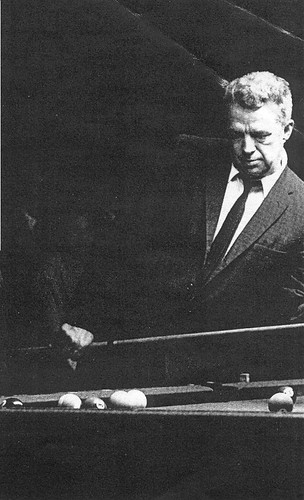
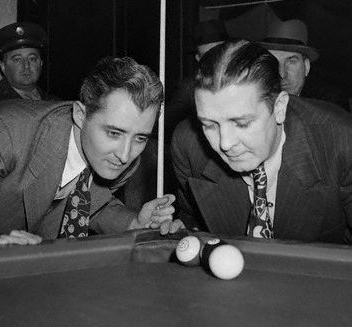
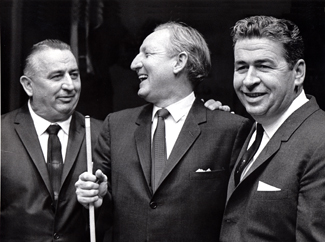
George Jansco, left, and brother Paulie, right, seen here with 1993 Hall of Fame inductee Eddie Taylor. Why aren't George and Paulie in the Hall of Fame?
The newest inductees into the Billiard Congress of America Hall of Fame were announced last week by the United States Billiard Media Association. Kudos to Danny DiLiberto and Ralf Souquet. The official induction ceremony will be held Oct. 20, during the U.S. Open 9-Ball Championship in Chesapeake.

Hall of Fame induction can mark the culmination of a grand career. Past winners include Johnny Archer, Alison Fisher, Willie Mosconi, Ralph Greenleaf and the great Willie Hoppe.  The most important promoters of the game, such as American Poolplayers Association founders Larry Hubbart and Terry Bell, have also gained entry. But several important personalities have been skipped over through the years — some because of BCA rules, others because they were active so long ago that they have been nearly forgotten.

For this edition of Pool Synergy, I've listed 10 dead guys who are not in the Hall of Fame but should be.  I've limited this list to the dearly departed, although there are plenty of folks among the living who deserve induction. I'd like to thank Mike Shamos, the great Billiards Digest historian, for help with the list. The players and promoters are listed in alphabetical order, not by order of importance.

1. Bennie Allen (1890-1953)
Allen was the U.S. 14.1 champion in 1913, 1914 and 1915. In 1950, he became he first U.S. National Snooker champion. Allen is the only three-time winner of the national 14.1 title who remains outside into the Hall of Fame.


2. Steve Cook (1946-2003)
Cook was the all-around champion in 1970 of the Las Vegas Stardust Open, then the richest tournament in pool.  Cook already has been inducted into the One-pocket Hall of Fame. However, he has been kept out of the BCA Hall of Fame because he has not won a BCA recognized world or national title, which is required for BCA induction.


3. Maurice Daly (1849-1932)
Daly was the U.S. 4-ball champion in 1873, the carom champion in 1873 and 1875 and the World cushion caroms champion in 1883.  Incredibly, he also was the teacher of Willie Hoppe and the author of Daly’s Billiard Book, which at one time was America's best-selling sports book. 
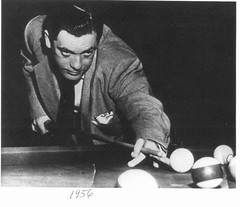
Rags: Best 1-Pocket Player Ever?


4. Johnny "Rags" Fitzpatrick (1918-1960)
One of my personal favorites, Fitzpatrick was best known as a 1-pocket player, but possessed great skill at the other games. Some believe Fitzpatrick to have been America's best-ever one-pocket players. He was inducted into the One-Pocket Hall of Fame in 2006.

5. Allen Gilbert (1939-2006)
Gilbert, who resided in Los Angeles, won the United States National 3-Cushion Billiard Championship on seven occasions. He was also the author of Systematic Billiards and a respected billiards instructor.


6. Thomas Hueston (Unknown-1940s)
Hueston won multiple championships in continuous pool (a precursor of straight pool), in straight pool and in three-cushion billiards. Hueston held both the pool and three-cushion titles at the same time.

7 & 8. George & Paulie Jansco (1915-1969, 1918-1997)
The Janscos created the famous Johnston City Tournaments, which helped transform pool into what it is today. They also created the Stardust Tournaments in Las Vegas. The Janscos were inducted into the One-Pocket Hall of Fame in 2007.

9. Jerome Keogh (1873-1953)
Keogh won the continuous pool championship many times over — but more importantly, he was the actual inventor of straight pool. How many people can make such a claim? It's incredible that Keogh has not yet been inducted into the Hall of Fame.

10. Don Willis (1909-1984)
Willis was remembered as one of America's finest hustlers and a great friend and road partner to Wimpy Lassiter. Willis was a great 9-ball player, but he always avoided tournaments.


About PoolSynergy
PoolSynergy is an online collaborative effort by pool and billiard bloggers, in which each agrees to write about a single theme. To read a list of the other fine contributions this month, check out Sam Diep Vidal's excellent Pool Tip Jar blog, which you can find here.  If you have a question or a suggested topic for the PoolSynergy project, please send it to R.A. Dyer, care of this email address. 

Friday, July 15, 2011

PoolSynergy21: Questions for La Voyante!

 Dear La Voyante, the Mysterious: 

I an older player, and I have been away from pool for a very long time. How can I improve my game after such a long lay-off? I'd like to get back up to speed, but I don't even know where to begin! With your mysterious arcane abilities, I know you can help me.

 Signed,
 Rufus from Texas


Funny you should ask, Rufus. As it turns out, the very same question has been posed for the 21st edition of the PoolSynergy project, the online collaborative effort in which pool bloggers write about a single topic. As a fond reader of PoolSynergy and a devout practitioner of the arcane arts, I, La Voyante the Mysterious, have bent my entire will to answering this very excellent question.

Joe "The Meatman" Balsis
The stars tell La Voyante that the answer you seek is in the possession of one Joe Balsis, a professional pool player. The stars also tell La Voyante that Mr. Balsis has unfortunately been dead since 1995, so getting instructional advice from him may be a challenge.  However, no man, living or dead, is better suited to seek it than La Voyante!

Why is Joe Balsis, the one they call "The Meatman," the key to your question? It is simply this: Mr. Balsis was a national champion as a young boy, abandoned the game shortly after World War II, but then came back 17 years later to become champion again. Historians tell La Voyante that Mr. Balsis holds the American record for the longest layoff in championship pool. 

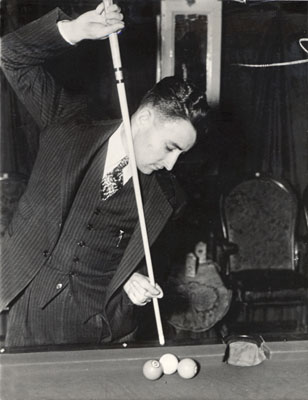
La Voyante is a great man, but also a humble one, and so he turns to the expertise of George Fels, the Billiards Digest columnist, for more information about the one they call The Meatman. La Voyante has learned from reading Mr. Fels' expert columns that The Meatman was the son of a poolroom owner from Minersville, Pennsylvania, won the Philadelphia City Boys Championship in 1932 at age 11, and then went on to win four consecutive National Junior Pocket Billiard Titles. So famous was young Joe Balsis that his picture appeared in The New York Times, right next to fellow pool stars Ralph Greenleaf and Willie Hoppe.

George Fels
But Joe Balsis abandoned the game shortly after World War II. Instead of pool, Joe Balsis went to work for his father-in-law's meat business.  “Thus began the professional game’s longest known layoff,” Mr. Fels tells us.  The Meatman earned both a good living and his troubling descriptive nickname during these years.

Another of La Voyante's Favorite Books
It was after the birth of his third child that Joe Balsis returned to pool. The sport was gaining again in popularity, largely the result of the Paul Newman film, The Hustler, which was released in 1961. (You can read about the renaissance sparked by that book in one of La Voyante's favorite books, Hustler Days.) In 1964 a Philadelphia room owner sponsored Joe Balsis for the prestigious Billiard Room Proprietors Association of America tournament, held in New York. It would be the first big tournament after his comeback. The Meatman finished with a 7-6 record, just passably good, but then would go on to win the BRPAA tournament outright the following year. Joe Balsis could now claim junior and world championships an incredible 32 years apart.

In 1966 Joe Balsis placed second to Irving Crane in the Billiard Congress of America’s inaugural straight pool U.S. Open in Chicago, won the Johnston City all-around, and took out Willie Mosconi during a high-profile competition in California as Mosconi was attempting his own return to pool. Mr. Balsis during this California event beat Mr. Mosconi in the finals and also pocketed an average of 22 balls per inning during the tournament, shattering an old record held by Mosconi. (You can read more about this tournament and about the prickly Mr. Mosconi in The Hustler & The Champ, another of La Voyante's favorite books.)

La Voyante's Pool Instructional Device
According to Mr. Fels: “In the first 28 months of his professional pool career, Balsis competed in 10 major tournamens, wining five, second once, two fourths, two fifths. Overall, between 1965 and 1975, he may well have been the world’s best player … His peers shuddered at the thought of taking him on just as they once had been in awe of Mosconi.”

Mr. Balsis was inducted into the Billiard Congress Hall of Fame in 1982.

So, Rufus, back to your question: How should one train after a long lay-off from the sport? Only Joe Balsis can know for sure. After all, no man, dead or alive, has made such a come back as The Meatman. For your answer, La Voyante shall continue to consult his Ouija board. When La Voyante hears from the great beyond, so shall you!

About PoolSynergy
PoolSynergy is an online collaborative effort by pool and billiard bloggers, in which each agrees to write about a single theme. To read a list of the other fine contributions this month, check out PoolBum's excellent blog, which you can find here.  If you have a question for La Voyante or a suggested topic for the PoolSynergy project, please send it to R.A. Dyer, care of this email address. 

Wednesday, June 15, 2011

PoolSynergy20: The Hustlers' Jamboree


I’ve been thinking a lot about Johnston City lately, especially given that the 50th anniversary of the Hustlers Jamboree is just around the corner.  For those who have never heard of it, the famous tournament started out as a tiny backwoods affair. Eventually, however, it grew into one of the most celebrated pool competitions in American history.   The first Johnston City event featured one-pocket only and almost no spectators. The last had nine-ball, straight-pool, one-pocket — and so much gambling that it was raided by federal agents.


I've written plenty about Johnston City over the last several years and as a consequence I've received several letters from folks who witnessed all the mayhem first hand.  For my PoolSynergy contribution this month I figured I'd turn those letters into gold. Our assignment was to describe what makes for a great tournament experience.  Who better to opine about this topic than folks who were present for America's great Hustler Jamborees?


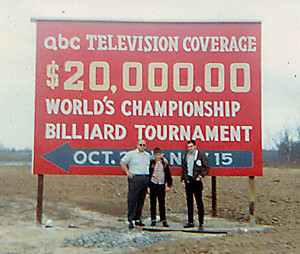
But before we get going, let me first provide the Cliff Notes explanation as to why you should care about Johnston City. As noted previously, the first of these events was conducted in 1961. The last was in 1972. They were organized by the brothers George and Paulie Jansco and drafted off the popularity of The Hustler, the famous movie featuring Paul Newman and Jackie Gleason. The tournaments were noteworthy for many reasons, not the least of which was their elevation of nine-ball as the official tournament game of pool and because they helped to establish Minnesota Fats as America's most famous pool player.  The tournaments were also the first significant pool events to bring gambling out of the shadows. In fact it was the gambling —and the romance that surrounded it —that attracted the national media to Johnston City.  Whether for good or bad, this is simply a fact.
Johnston City Sign
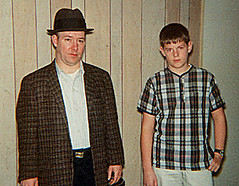
Ross Parker Simons, center, with his Dad and unidentified man.

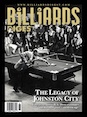
For those who are unfamiliar with the events, I've written a retrospective essay in this month's Billiards Digest. You can find it here.  There's also plenty of information about Johnston City in Hustler Days and The Hustler & The Champ.  I maintain a separate Johnston City blog with plenty of anecdotes, pictures and video about the event, which you can find here. And just above I've reproduced a video of the famous Minnesota Fats holding forth in Johnston City.

And now on to the letters:


          Gary Carlson writes that in 1965 or 1966 he piled into a Chevy Impala with a friend and the two drove down from Decatur, Illinois to Johnston City. And that's where he witnessed the famous "toilet brush" incident.


"I didn’t know what was going on — I knew nobody. The place was wall-to-wall packed. Difficult to see the action and it seemed somewhat disorganized. After watching endless 9-ball, we learned that the more interesting stuff was going on “out back.” I can’t recall (after all, this was about 45 years ago) if it was in a part of the same room walled off or a small building separate from the main room. I think we paid $5 for entry. It was north of the main building (which was like fifties deco), the latter which sat on the northwest quarter of the intersection. In any case, we were there only maybe a couple hours and the only memory I have was in this back room. I recall or heard of or saw “Jersey Red,” Eddie “Knoxville” Taylor, and “Big Daddy Warbucks” who I much later learned was Hubert Cokes. The match I recall was between Big Daddy and somebody else — I can’t recall who —seems like Taylor, but I’m not totally sure if Taylor or Red were even there that year and I just heard their names — but it was certainly Big Daddy. I also remember a LONG conversation about what the handicap would be. The game was going to be 8-ball and a race to something for $100 (good money back then). Now, instead of their bridge hand, Warbucks was to use his hat for a bridge and the other guy went into the toilet and returned with a big toilet brush." 

And here’s a note from John Rousseau, who read my Billiards Digest essay: 

“I am glad I went to Southern Illinois during that period and got to go to Johnson City every day. Grades sucked but it was quite an experience on life. I was there that night thanks to my deceit and larceny. The tickets for the broadcast were very expensive so I bought extra tickets for the regular tournament as they had no date or reference to ABC. We made a stink at the front door when they refused to admit us when Jim McKay yelled out, this is f------ live, let the a**holes in!”


Ross Parker Simons in 1965 with Boston Shorty.
Ross Parker Simons was just 13 when he want to Johnston City. That’s a picture of him on the right and above. Here's what he has to say: 

“When I was 13, my father took me out of school is Wisconsin for a road trip to Johnston City and the Jansco Brothers 1965 tournament. I don't recall my mother's reaction, although she couldn't have been too mad as she packed a cooler with fried chicken and seven ounce bottles of Schlitz for the overnight drive. ... Although I don't recall much about the games, I knew good pool and remember that Harold Worst was impressive.  Looked like a haberdasher and shot like a machine.  I also liked to watch one pocket.  What's funny about the picture of Boston Shorty now that I look at it is his bored sneer... like beat it kid.  But I don't remember anyone being rude to me, even the imperious Daddy Warbucks.  Saw Handsome Danny Jones there and he was, in fact, quite handsome.” 

You can read more at the Johnston City blog, including some recollections of Karen Fox, whose husband co-authored the autobiography of Minnesota Fats. And if you were old enough to remember Johnston City, please drop me a line.


Before I sign off, I would like to leave you with this last thought. I believe it's high time that George and Paulie Jansco, the late promoters of Johnston City, were inducted into the Billiard Congress Hall of Fame. They've already been inducted into the One Pocket Hall of Fame, but now it's time for them to be honored by the BCA. If you agree (or even if you don't) send a note to Billiards Digest or your favorite pool magazine.

About PoolSynergy
PoolSynergy is an online collaborative effort by pool and billiard bloggers, in which each agrees to write about a single theme. PoolSynergy submissions are published simultaneously by each of the participating blogs on the 15th of every month. To read a list of the other fine contributions this month, check out Mike Fieldhammer's excellent Billiard Coach blog, which you can find here.

Sunday, May 15, 2011

PoolSynergy 19: The Norfolk Glory Years

The Greatest Pool Town In American History?
Wimpy Lassiter

There are pool meccas and then there are pool meccas. Our PoolSynergy task this month is to pick one and write about it. But as I deal with history here, for my essay I’ll reach back into time and describe one of the great pool towns of the past.

I’m not talking Johnston City.  I’m not talking Los Angeles or Chicago. I’m talking about Norfolk, Virginia, during World War II: the town where Wimpy Lassiter was king. Norfolk was the home of the the famous Tuxedo, the town’s main action room. The Tuxedo was located downtown, on City Hall avenue. But there was also St. Elmo, with the flashing ball and stick above the door, and the Monroe and the Eureka.

I describe Norfolk at great length in my book Hustler Days, which chronicles Wimpy Lassiter's rise to greatness there. Norfolk was a navy city, and the sailors and shipbuilders flooded in during World War II, tripling the city's population. This meant: suckers. And so the sharks came too, men like Andrew Ponzi, Johnny Irish, Rags Fitzpatrick, Earl Shriver, New York Fats, Joe Canton.

And of course there was Lassiter, remembered today as one of the greatest nine-ball players in American history. He won and lost several small fortunes in Norfolk. An old friend of Lassiter’s, Rusty Miller, explained to me how the former Coast Guard man would skip off the boat at night, looking for action.  “All these people were making bucketsful and bucketsful of money,” said Miller, who was in his teens during the war years.  “They had so, so much money.  I was used to playing for 50 cents or $1 nine-ball. I remember walking into a poolroom and I saw Wimpy playing $250 a game – and this was 1944! I was totally flabbergasted.”
          
Lassiter was stationed on a Coast Guard vessel in Norfolk.
Miller remembered as many as six poolrooms in Norfolk, all within walking distance of each other. There were payoffs to the cops and wide-open bookmaking, he said. "The Coast Guard pay started at $21 a month, but Wimpy would pay $50 a night (for a shipmate to take his duties). The kids on the ship would line up to stand in for Wimpy (so he could leave the ship and gamble). At a salary of $21 a month, that $50 per night looked pretty good."

Norfolk was also the home of the Commando Club, an illegal nightspot owned by a well-to-do gambler named Whitey. Whitey would boast that he easily cleared $10,000 weekly off his entertainment ventures. And it was money Whitey was willing to gamble. “All the pool players migrated to Norfolk to play Whitey pool,” said Miller. “I remember seeing him lose $22,000 in a single day. And the next day, the same guy (who beat Whitey) lost most of that money. I saw every famous pool player known to man come to Norfolk to play Whitey.”

More about Norfolk in Hustler Days.
It was also against Whitey, in Norfolk, that Lassiter played what has been described as one of the greatest money matches of all time. As Miller remembered it, Lassiter had just beat Whitey of $5,000 playing nine-ball. “Whitey quit him, and then when he quit, Whitey’s throw-away line was: ‘How would you like to play one game of straight pool for $5,000? Just one?’
        
 “Wimpy looked at him and said, ‘Well, yeah’ – and they played one game of straight pool for $5,000.” The game was set, Wimpy gave Whitey a giant spot ... and then Wimpy managed to sink just eight balls. Whitey, meanwhile, got to 98. That is, the club owner was just two points from victory. And that's when Wimpy got back to the table. “And then Wimpy ran 82 and out,” said Miller. “I watched it with my own two eyes.”

About PoolSynergy
PoolSynergy is an online collaborative effort by pool and billiard bloggers, in which each agrees to write about a single theme. PoolSynergy submissions are published simultaneously by each of the participating blogs on the 15th of every month. To read a list of the other fine contributions this month, check out the JB Cases blog, which you can find here.

Tuesday, March 15, 2011

PoolSynergy 17: Expert Tourney Tips


Every month a bunch of men and women who blog about pool agree to post essays about a single topic. This collaborative effort is called the PoolSynergy Project. This is our 17th installment. 

Our topic for March is tournament and league preparation.  Since I don't typically play in either, I figured I'd turn to the experts. I asked folks on my Pool & Billiard History Facebook page (you can find it here) how they prepare for competition. I've reproduced a sample of some of the responses, with a bit of editing for space.  And just above, I've reproduced video of some useful drills from regular PoolSynergy contributors Samm Diep and Mike Fieldhammer. You can find other PoolSynergy essays this month at ForumGhost516's blog, linked here.

Missy Moran Capestrain (Certified BCA Instructor and League Coordinator): 
Players should always practice alone before a tmt or league play. To increase confidence they should do a progressive practice. This means begin setting up a very easy shot and shoot it in, including the use of the basics mechanics, feel, preshot routine. Beginning with easy shots builds confidence. Next put some space between the cue and object balls and shoot this shot. If done properly and the shot is made, increase the distance again — 6 or so inches at a time is a good rule of thumb. Keep doing this until there is a lot of green between the balls and the shot is consistently pocketed. Not only can the player practice tough shots using this method, they also get to practice all of the shots in-between. Confidence is gained every step of the way with successful pocketing of balls.
Source: 9-Ball Grand Prix Open (Own work)

Another idea is to use the same amount of practice strokes on every shot —except for maybe the very difficult ones. This is not only good practice, but it helps players to drown out unneeded outside interferences like sharking, loud music, and noise.
 
Skyscraper Chris:
When I was in a slump last year, around February, I realized I needed to desperately change my game. I had the ability to win, I had the knowledge, and I had the skills — but I was lacking in the mental toughness and stamina. So I made 3 changes not to my game per say, but to my playing habits:

First, I stopped drinking soda while playing, which I noticed was making me dehydrated, caused me to sweat and shake during some matches, and generally affected my physical well being while playing.

Second, I began keeping a close record of all my tournament matches, including wins, losses, weight given/taken, players and their ranks, etc. I still keep this up, and it motivates me to raise my numbers, sort of like an Accu-stat.

Finally, I changed something fundamental in my game: I am known for breaking and running 6 or 7 balls, then dogging the final 2 balls. This was not because I lacked the ability to make those balls, but because I mentally dogged the shot, doubted myself, or didn't focus enough. So, I decided that when I got down on a critical shot (money ball, key ball, final ball), I would 'dog' the shot in my mind, thus getting it out of my system, get up from the shot, chalk up, get back down with a clear mind, and pocket the ball confidently.

Since making these changes to my game, I have won dozens of tournaments, leveled up 3 times, won many more money matches, and increased my confidence. Before the changes, I hadn't won a single tournament.

Elijah Davenport:
Always think positive. Talk yourself into a shot, not out of it. Also take as much time as is allowed and needed. Remember, don't be in a hurry to miss.
 
Nick Baker: 
I noticed that when playing league AND tournaments alike that if I "dogged" a shot, or even worse —if my opponent dogged a shot and got lucky shape from the miss, that I would become timid with my shots. I found that approaching those shots like my opponent had played a great safety and really concentrating on "turning the cueball loose" greatly helped my confidence level. After hours of drills and practice, I just trusted my stroke and my first instinct on each shot and could usually rebound from my mistakes or kick out of whatever situation my opponent had put me into.

Cathy Jo Sawyer Almanza (player and tournament director): 
Many players start out by playing in a league and once they get better they start entering tournaments. Since tournament rules usually do not allow "group party socializing" during a match, my prep advice is for all players to recognize the differences in singles competition and group play, and to always conduct themselves appropriately for the type of event that they are participating in. 

  
-- R.A. Dyer

Saturday, January 15, 2011

PoolSynergy 15: Earl, Willie and Team Pool


In the youtube video, above, Earl "The Pearl" Strickland illustrates why some believe pool should remain an individual endeavor. It was taken during the 2006 Mosconi Cup, conducted in the Netherlands.  Judging from the video, it appears that Earl's cue did not simply break, but actually exploded. I love the obnoxious air horns, the wiseacre heckler. I can't speak Dutch, but I imagine he's congratulating Strickland for a job well done.

Phoning it in
For this month's edition of PoolSynergy, we've been asked to write about pool as a team sport. I have to confess that I do not play pool as a team sport, and so have few ideas on the topic and no over-arching theme this month. In other words, I'm phoning it in. That's a picture of me doing so, at right.

I do, however, have two unrelated observations -- one from me, and one from Hall of Fame player Nick Varner.

Willie Mosconi: team player?
First Observation: Let's talk about the Mosconi Cup. It's a great event. I find it ironic, however, that what must be considered the most high-profile team event in pool is named for a man who, like Strickland, did not always play well with others. William Joseph Mosconi, one of the greatest players in the history of our sport, was famously moody, a man with little patience for fools. Mosconi would stomp about during tournaments, chastise overly loud audience members and once allegedly attacked a tournament promoter. But boy could Willie play.

Would you want him on your team? And how about Ralph Greenleaf? The legendary player was drunk more often than not. His out-of-control antics even led to an eventual ban from tournament play. Mosconi and Greenleaf played at least two exhibition tours together, but, as far as I know, were never teammates in competition.

Nick Varner
Second Observation (from Nick Varner): As you may recall, I asked Nick some time back about his ideas for fixing pool. The Hall of Famer is the first man in history to win back-to-back titles in the U.S. Open. He's been playing and promoting the sport for years. Varner said one key to future success could be team play. He imagined the possibility of a domestic tour, but with groups of players representing individual U.S. cities or states. In the Mosconi Cup, it's the U.S. versus Europe. With Varner's idea, it would be Texas versus New York, or Los Angeles versus Cleveland.

Varner calls the Mosconi Cup one of pool's most exciting events. He has participated both as a player and as the U.S. team captain. "To really make this game (successful) we need to figure out how it could be economically feasible to have teams like in the NBA or the NFL," he said. "We could have state teams. This creates a geographic fan base. Right now there isn't a whole lot of team stuff going on. But with a Georgia team versus Florida, say, that automatically hits us like a college sport. This (attracts) the sports fan."

Part of Earl's Strategy All Along?
And finally, a note about the video, above. After his assault on that poor defenseless cue,  Earl went on to win his match against Team Europe player Thomas Engert by a score of 7-4. The event that year ended in a 12-12 tie, a good enough showing for the Americans to retain possession of the Mosconi Cup.  It was the only recorded tie in the history of the event.

With Earl on the Mosconi Cup team, the Americans have amassed a record of nine wins, three losses and one tie.  Two of those three losses and the tie came after 2006, well after Earl's heyday as a player. Without Earl, the Americans have amassed a piddling record of two and two.

What does this tell me? First, that during Strickland's heyday the Americans were nearly unstoppable. Of course it's true that teammates like Johnny Archer and Corey Deuel had something to do with the team's winning ways. But it's hard to argue with the Americans' success during Earl's glory years.

Therefore I conclude that when Earl is at the top of his game, you want him on your side. Antics or not, The Pearl wins games. If I could create a dream team, I'd also want Willie Mosconi and Ralph Greenleaf. Imagine the mayhem! Imagine the chaos!

What do you think?

About PoolSynergy

Pool Synergy is an online collaborative effort by pool and billiard bloggers, in which each agrees to write about a single theme. PoolSynergy submissions are published simultaneously by each of the participating blogs on the 15th of every month. To read a list of the other fine contributions this month, check out the Kicks, Banks, Caroms and Combos blog, which you can find here.

Friday, October 15, 2010

We Lose Again?

Pool Synergy 12: Pool & Television


Eddy & Charlie: "We lose again?"
Remember this scene? Fast Eddy is shooting pool. He’s been at it for hours, days even. At first Eddy wins big. But the Fatman keeps coming at him, keeps stroking balls, confidently, quickly, one by one. And eventually it all goes south for Eddy. Charlie the stakehorse sits dejectedly to one side. At Charlie’s feet are enough cigarette butts to fill a small pot hole.

The end comes miserably for Fast Eddy.

“We lose again, Charlie?” he asks, already knowing the answer.
“We lose again,” says Charlie.

We all face defeats. Some are trivial. Others sting. The worst are those that come when victory seems so tantalizingly close. These are the soul crushing defeats of come-from-behind candidates, of foreclosed homes and failed marriages. These are the overtime losses that keep the hometown team out of the Super Bowl, of finishing second best.

To me, that scene in The Hustler has always been a metaphor for just this sort of loss. This month's edition of Pool Synergy is devoted to what could be another: the very real possibility that pool will vanish from television.  Our Pool Synergy host predicts that soon, very soon, most American TV coverage for pool will be a memory. “It’s fairly safe to say that sometime within the next couple of years, the only billiards events we'll see here in the states will be trick shots and speed pool,” he writes.

His question: what impact will this have on our sport?

Quick review. Pool Synergy is a monthly collaborative effort in which online pool writers take on a single theme. This month our host, the anonymous founder of the Pool Cue News and Review blog, poses a question that I believe can be answered with but a single word. No essay required. The loss of TV coverage for pool would be disastrous.

But there is hope. Our anonymous host takes it as an article of faith that coverage will fade away. The eternal optimist in me rails against this proposition. I agree our industry has entered into some dark days. But I also believe the changing nature of television should open up new opportunities.

In 1978 Minnesota Fats faced Willie Mosconi in The Great Shoot-Out. It was the most watched pool competition in U.S. history, its rankings commensurate to some World Series games. (Read all about it in The Hustler & The Champ.) But that was the age before cable, TiVo and youtube. Those days are history. Today, television is granular, a medium in which giant ratings are almost unheard of, but where there’s space for relatively low-rated events like hot dog-eating contests, hot rod shows and poker. There’s never been a time with so much bad TV. Or so much good.

It’s been said that reality TV may presage the fall of Western Civilization. But what about reality TV devoted to professional pool? I opened the question recently to folks on my Facebook page. The response was enthusiastic. Said one reader: “It is incredibly frustrating to hear that the country's most popular sport (yes, pool is played by more Americans than football, baseball, soccer, basketball, or midget horseback racing) is lacking so heavily in TV coverage, yet there are shows about 'ice road truckers'? Ridiculous.”

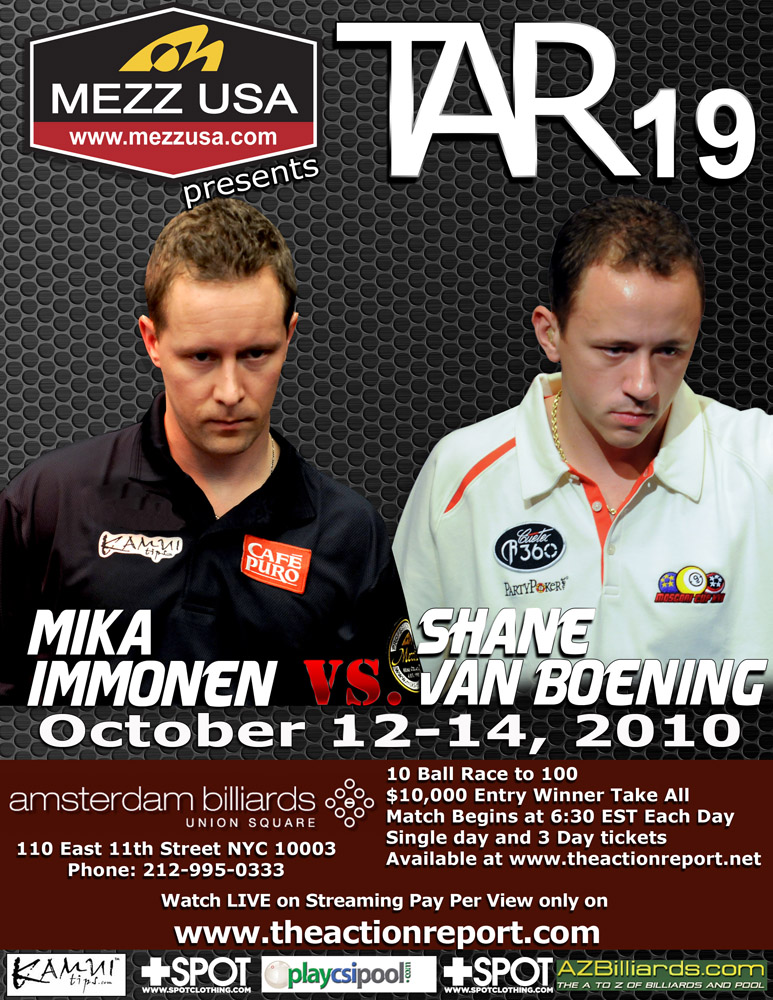
I’m also heartened to see what The Action Report is doing. The recent challenge match between Shane Van Boening and Mika Immonen provides an excellent road map for what could sell on cable. Same rules: $10,000 entry fee. Winner takes all. I imagine hand-held camera shots of serious looking men counting cash stacked in piles. As an added touch the TV producers could have the cash prominently displayed throughout the entire contest. The camera could pan back to it before each commercial break. A little bit of pre-match trash talk also would help.

Why wouldn’t that work? Am I dreaming? It would have the same feel as the Fast Eddy versus Minnesota Fats challenge match in The Hustler, but made for reality TV. It seems to me that such events would be relatively inexpensive to produce, and that venues would jump at the chance to host them because of the potential TV exposure. You could even pit a top woman pro against a top man. Bill it as the battle of the sexes. Imagine the drama. Imagine the pathos. And because of the granular nature of today’s TV audiences, the producers no longer need out-of-the-park ratings to declare success.

The down side would be that two-person events would limit exposure for other players. But such events could become a first step, something to help our sport rebuild in the new media age. In my dream world, broader coverage would follow. I agree with one reader, who wrote me recently that he wanted more “real” pool on TV – games like some straight pool, one pocket or some bank pool. “When I watch pool I want to see the skill, the heart, and the look of determination on the players faces,” he said.

The challenge match format could fit the bill.  The alternative is that our sport will continue its fall into irrelevance. The result, in a word, would be disastrous.

We lose again Charlie?

Thursday, March 18, 2010

Pool & Gambling: The Debate Continues

I notice a lot of give and take from PoolSynergy writers and readers this month on the issue of pool and gambling.

Justin Collett, founder of The Action Report, praises the drama of one-on-one action featuring top players. "It really is no secret it is as old as time -- people want the drama of a contest," Mr. Collett writes in comments at the bottom of my PoolSynergy post, which is just below this one.

John Biddle, founder of the PoolSynergy project, argues that gambling is bad for the sport's image. "Pool has a very active gambling culture that harms the sport and many of its players, limits it audience and turns off potential sponsors," writes Biddle in his PoolSynergy post. You can read it here.

I write in my post that the opposite might be true -- at least with regards to Biddle's assertion that gambling has limited our sport's audience. It was, after all, the public's fascination with pool gambling that helped propel the popularity of The Hustler, the 1960s film starring Jackie Gleason and Paul Newman. That film ushered in a decade-long renaissance for the sport. I would also argue that the public's fascination with pool gambling helps explain the astronomical TV ratings of the Great Shoot-Out, which pitted Minnesota Fats against Willie Mosconi. The challenge match was the most watched pool event in American history.

One other observation: Mr. Collett notes that while his website "is about the action side of the game," it's also much more than that. "No one has done as much coverage of the high end custom cue scene as us as well as streaming traditional events like the WPBA, US Bar Table Championships, and the upcoming US Open 10 Ball," he writes. Again, you can read Mr. Collett's comments at the bottom of my PoolSynergy post, which is right below this one.

And by way of background, PoolSynergy is an online collaborative effort between pool writers who post essays each month about a common theme. You can read more about PoolSynergy here. You can also cast your vote on the issue of pool and gambling at the online poll, which I've posted up in the right-hand margin of this blog.

-- R.A. Dyer

Monday, March 15, 2010

PoolSynergy 5: Pool and the Sporting Life

This is the fifth in a series of posts written in coordination with other online pool writers. It's part of the Pool Synergy project hosted this month by Alison Fischer at NYCGrind. Look for more PoolSynergy installments in the future.

I note with interest the on-gain and off-again debate about The Action Report, which, as many of you know, is that online site devoted to high-stakes pool gambling. Founded by Justin Collett, The Action Report (better known as "TAR"), streams gambling sessions -- sometimes very expensive gambling sessions -- featuring our sport's top players.

The question is this: is glorifying gambling good for pool or bad for it?

“There seem to be two schools of thought when it comes to this,” writes the anonymous blogger responsible for the online Pool Cue News and Review. “One camp will tell you that all TAR is doing is embracing what pool has always been. The seedy side of pool has a reputation for gambling and TAR is simply putting it up on a pedestal. The other camp will tell you that pool is a sport that should be recognized as such and the only way it will find its way into the mainstream (and the Olympics) is if the industry sheds its seedy reputation.”

It’s a fair question, and a particularly appropriate one considering our PoolSynergy topic this month. In case you haven’t been following along, PoolSynergy is a collaborative effort between online pool writers, each of whom agree to post essays on a single theme. Our topic this month is “Pool and the Mainstream,” which I take to mean: “How will pool ever gain legitimacy with the mainstream media and the general public?”

And this takes us back to the question of TAR, a website devoted to what many would deem the seedier aspects of pool. Does glorifying gambling help promote our sport, or does it harm its image?

Although the Pool Cue News blogger doesn’t come down one way or the other on this question, he does note that TAR's market strategy is not much different from the one employed by the city of Las Vegas. That is, Las Vegas gave up trying to promote itself as a "family-fun" destination -- that clearly wasn't working -- and instead now promotes itself for what it truly is: a city where you can go gamble.

I also won't come down one way or the other in this debate. But I will provide this bit of historical context. Know that pool's conflicting duality -- that is, the tension between respectability and tawdriness that is illustrated in the TAR question -- has been with the sport always. The game may have began as a pastime for nobility, but it soon migrated to the public rooms, where it then became a favorite of “blacklegs” and ruffians.

Even the term “pool” refers to the gambling "pools" that were commonly operated in 19th Century parlors where one often also would find a billiard table. As historian Mike Shamos points out, it was a linguistic misunderstanding -- that is, the habit of calling these betting parlors “pool rooms” -- that gave our sport its very name.

Brunswick later tried to clean up the sport’s image by attempting to change its name to "pocket billiards.” But like the attempt to project a family-fun image for Vegas, this really didn't take. As anyone who plays in an APA league knows, we’re pool players, not pocket billiard players.

There was also a great hue and cry over the release of The Hustler, a film that did more to bring our game to the public's attention than any single cultural event of the last 50 years. And yet thematically it's focus was exactly the focus of the TAR website: pool gambling. Willie Mosconi, who served as a technical adviser for the film, got an earful from his friends in the industry after its release. They thought the film would wreck the sport. Instead, it sparked a decade-long renaissance.

Likewise, the most watched pool match in history – the Great Shoot-Out between Mosconi and Minnesota Fats – embodied the tension between these two very different faces of pool. Mosconi represented its clean-cut image. Fats represented the gambling. The ABC broadcast had ratings commensurate with some World Series games. I would argue that it was this very tension between the sport's gambling image and its clean-cut one that helped propel its ratings.

Younger readers who have never seen The Hustler should do so immediately. It’s great. And if you're interested in looking at footage from the Great Shoot-Out, I have some posted up here. There's also my two books, Hustler Days and The Hustler & The Champ, that deal extensively with these questions.

So, do outfits like TAR -- that is, those who would romanticize pool's sporting life -- provide for us a way forward? Or, given the general apathy exhibited by the public, should we move away from this image as we look to bring our sport into the mainstream? I think these questions are among the most important for our sport.

-- R.A. Dyer

Monday, February 15, 2010

Greatest Player Ever? Greenleaf or Mosconi?

This is the fourth a series of posts written in coordination with other online pool writers. It's part of the Pool Synergy project hosted this month by Gayle Glazebrook's Confessions of G Squared. Look for more PoolSynergy installments in the future.

A handful of athletes have been elevated by almost universal acclamation as the best-ever in their respective sports. In baseball, it would be Babe Ruth. In basketball, probably Michael Jordon. But pool? Who’s the best ever at our sport?

I recently conducted a poll at this site in which I asked readers precisely this question. I limited candidates only to U.S. players, and only to those known for pocket billiards. That meant that Filipino Efren Reyes and three-cushion player Willie Hoppe — two of my personal favorites — didn’t make the list. You can find the results on the sidebar at the right. (You have to scroll down a bit.) As expected Luther Lassiter, Mike Sigel and Steve Mizerak all got plenty of votes — as did Shane Van Boening. But the two top vote getters (and this shouldn’t come as a surprise either) were Ralph Greenleaf and Willie Mosconi. Both had long and dominant careers. Both smashed records. Both were feared by the competition.

Neither Greenleaf nor Mosconi, however received a majority of the votes. Mosconi came close, but still was held to below 50 percent. So in the spirit of true democracy, I'm conducting a runoff. It's time we came to the bottom of this very important question.

This month’s PoolSynergy column I devote to these two fine players. Consider it an advance on an upcoming Untold Stories column for Billiards Digest. Our PoolSynergy assignment was to write about our favorite player. Well, I pick these two: Mosconi and Greenleaf. They had different temperaments, different playing styles, different reputations. But both were among the very best ever to play the sport.

I read online somewhere in which some knucklehead suggested that if Greenleaf and Mosconi were still playing today, they wouldn’t be able to stand up to modern talent. This is, in a word, horseshit. During his heyday, Mosconi killed the opposition with repeated 100-ball runs. Not occasional 100-ball runs, but repeated 100-ball runs. Over and over again. It was devastating. It would take the air out of the room. Sigel, in his prime, would run 100s — but never with Mosconi’s consistency.

Likewise Greenleaf, during his heyday, would slice through the competition — sometimes going through an entire double round-robin tournament without a single loss. And often he did so while drunk. Greenleaf started young, rose to the national stage at age 16, won his first world title a few years later, and then continued smashing the opposition for the next 13 years.

I recently posed this question to historian Charlie Ursitti: which player really was best. Charlie is an expert in the field, having recently created a website with more than a century of pool statistics. He is a man of strongly held opinions when it comes to pool. Charlie’s answer to me was emphatic. Without a doubt, he said, Mosconi was the superior player. Charlie says this is not simply his opinion, but rather the indisputable conclusion one must draw from examining the facts.

“I statistically proved that Willie was better,” said Ursitti, recalling to me an analysis he conducted some 20 years ago. “He (Mosconi) won 76.3 percent of the games and Greenleaf won 70 percent of his games.” Charlie said these numbers, first published in an article for The National Billiard News, did not sit well with Greenleaf's fans. “I got more hate mail than anybody had in 10 years. They’d say: ‘you don’t know, you never saw Greenleaf play.’ I said both of them played in competition, I never saw them (play against each other) — all I did was present the numbers. And the numbers don’t lie.”

That may be true but consider a few other facts. Greenleaf played more exclusively on the 5 by 10s. Mosconi played extensively on them, but was more known for playing on smaller tables. Greenleaf also was the youngest American ever to win a world straight pool championship, having been only 20 when he took his first title. Mosconi tried to beat that record, but came up short. And while it’s true that Mosconi may have had the slight edge in head-to-head competition, Greenleaf held it early on, when he was still playing in his prime. Recall that Mosconi was somewhat younger than Greenleaf — he was, in fact, Greenleaf’s protégé — and by the time that Willie was in his prime, Greenleaf was already on the way down.

Mosconi, in his own autobiography, says that Greenleaf beat him 57 games to 50 during a 1934 exhibition tour. And this was even though Greenleaf was dead drunk during many of the games. “All told, we played 107 games in 112 days,” wrote Mosconi. “Of course, Greenleaf was the principal attraction. He was not only a great player, but he was great to watch. He had looks and style, a theatrical flair, and a shooting touch so soft that only a connoisseur could fully appreciate it.”

So who really was the best? As I mentioned previously, I’m going to explore these issues further in an upcoming column. But in the meantime, I’m going to post up another poll. A runoff! You pick the best, Greenleaf or Mosconi. Vote early, vote often.

-- R.A. Dyer

Tuesday, February 9, 2010

PoolSynergy: Construction in Progress

Sorry. No post for today. That's because I'm working on my assignment for the PoolSynergy project, which is due tomorrow. If you're not familiar with PoolSynergy, scroll down to find some of my recent contributions. Or click here to read a recent one about pool and folklore. Basically the deal with PoolSynergy is that a group of online pool writers each agree to common assignments and then the writers post their contributions on the same day of each month, generally the 15th. The agreed-upon theme of the attached post was "billiard tales." (I wrote about folklore. That's close, right?) Our upcoming assignment is to write about a favorite player. If you're curious about contributing to PoolSynergy, contact organizer John Biddle at http://www.poolstudent.com/. Or you can also shoot me an email at R.A. Dyer

Thursday, January 14, 2010

Pichitas: A Costa Rican Pool Documentary


Pichitas: A Costa Rican Pool Documentary from R A Dyer on Vimeo.


This is the third in a series of posts submitted in coordination with other online pool writers. It's part of the Pool Synergy project hosted this month by billiardcoach.com. Look for more installments in the future.

As usual, I'm taking great liberties with my homework. Our PoolSynergy assignment this month was to write about "some activity, training, or experience outside of the world of billiards and how that could be applied to help a person's pool game." Well, first off--I'm not really going to write about anything. Instead I'm submitting a documentary, the one you see attached to the top of this post. It's called "Pichitas" and it's about Costa Rican pool players. And as for it describing an "activity, training, or experience that could help a person's game" -- well, you can be the judge.

The documentary is something I put together about 18 years ago. It ran briefly on cable access TV in Houston and then pretty much has been sitting in my closet ever since. I got my son to create an electronic file of the film that would be appropriate for use on my blog -- and viola -- here it is.

And so how, you may ask, does this film illustrate some activity outside the world of pool that can help a person's game? Well, the fact of the matter is that I came to pool largely because of my willingness to go exploring. I lived for several years in Costa Rica, spent much of that time wandering around the streets of San Jose, and finally ventured up the steps of "Center Pool," which is the pool hall featured in this film. There I met a wonderful cast of characters, some of whom were vaguely disreputable. I watched them play pool and I fell in love with the game.

So, that's it. Go exploring. Take risks. Learn about other people. That's the activity outside the pool world that led me to improve my game.

OK, I know it's a stretch -- but whatever. I was never much good at homework anyway.

-- R.A. Dyer

Sunday, December 13, 2009

PoolSynergy: Billiards Tales and Folklore

This is the second of a series of posts written in coordination with other online pool writers. It's part of the Pool Synergy project hosted this month by Samm Diep's pooltipjar.com. Look for more installments in the future.

Our PoolSynergy topic this month is “Billiard Tales.” As part of my contribution I'm giving everyone an assignment. Find a poolroom in your area popular with the old timers and sidle up next to a few of them at the bar. It’s important that you find at least two or three of these guys sitting together. Four is even better. And I’m not talking about the middle-aged guys, I’m talking about the really old ones, the guys who have been around the pool halls 30 or 40 years at least.

Buy them a beer if you want, or just sit quietly. And then wait.

I guarantee you that within the first half hour you’ll start hearing stories of who took whom and for how much, or about the time some shark came to town, or about the big score by the local champ. Some stories will be verifiable, others not so much. I’ve even heard deadly serious tales of the supernatural.

To me, the form of these billiard tales is just as interesting as the content. That is, it's not what the stories are about, per se, but how they're communicated. The oral tradition is key. Most of the great old stories never get written down, never appear in newspapers -- and they grow in the telling. These stories pass from older players to younger ones, and as long as the community remains intact -- e.g., as long as the poolroom remains standing and the same men and women continue to frequent it -- the legends remain alive.

Now here's a thought. Bear with me, but I think it's true. I believe these boozy recollections have a lot in common with the colorful stories that might get told by village elders around a camp fire. Listen to the old timers and you'll hear tales of heroes and villains and especially tricksters. Oral tradition (according to my quick research on Wikipedia) refers to the "transmission of cultural material through vocal utterance.” The oral traditional also has long been associated with folklore. I would argue that many of the stories told by old-time pool players are part of the folkloric tradition, but of an urban sort.

Some of my favorite Billiard Tales involve Minnesota Fats. In them Fats might be razzing an event promoter about the dress code, or cracking wise about the straight-laced "fun players," or gleefully robbing a tournament player during a high-dollar gambling session. These stories typically pits Fats against some symbol of the conservative billiards establishment.

As is the case with many trickster stories from folklore, Fats in these stories becomes an amoral and comic figure confronting the hypocrisy of the status quo. The billiards establishment would portray our sport as a clean-cut endeavor where no one ever gambles and where the dress code is strictly enforced. Minnesota Fats would portray it for what it really is. As a classic trickster, Fats confronts established authority, lies, and can act in amoral ways. But he also becomes an ironic symbol of truth.

I used to live in San Jose, Costa Rica. I remember hearing stories there about a hustler named “Pichitas” -- about how he would send well-dressed businessmen packing, or how he created this great shot from nowhere, or how he became a master of the 5 by 10s. I even remember the Pichitas "origin myth" -- in that stories were told about how he got his name (which, by the way, translates to “Tiny Dicks.”) These stories were told with something approaching reverence and at first I thought they were specific to Latin America. But I later discovered that they could have just as easily been told about Wimpy Lassiter or Jersey Red or U.J. Puckett. In each case, the players are portrayed as heroic or trickster figures, and in each case the stories are passed along directly through word of mouth. I also recognized in each case messages about the "culture" of the pool room, in that they would communicate lessons about such matters as gambling etiquette, attach value to certain sorts of figures and heap ridicule on others, and define the language common to members of the "tribe".

And so that brings us back to this month's assignment. Go sidle up to the bar, order a drink, and spend some time listening to the old timers. If you hear something good, remember it, and pass it along. Better yet, send me your stories and I'll post them up on this blog or use them as a fodder for a future Untold Stories column.

Some of the best Billiard Tales have never been written down. This puts them at risk for being lost forever. But through the magic of the Internet, we can now share the wisdom of our village elders with the world.

You can read a bit more about these ideas in The Hustler & The Champ. If you have your own old time story, send it to me at
hustlerdays@yahoo.com.