Monday, March 21, 2011

Eccentric Pearl Beats Young Gun

Strickland stuns fans, beats SVB in Challenge Match
Wearing ear muffs and arm weights, Earl "The Pearl" Strickland stunned pool fans this week with an underdog victory over Shane Van Boening, the young gun from South Dakota considered by many as America's greatest 10-ball player.

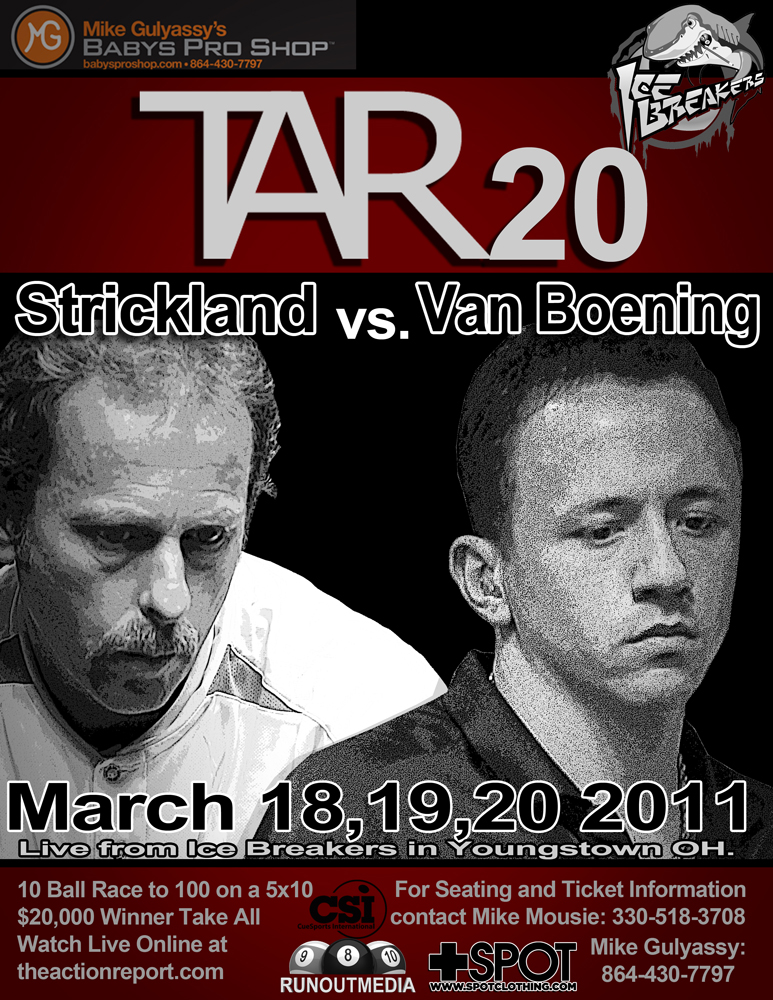
The two pool giants met in a 100-game winner-take-all challenge match held Friday through Sunday in Youngstown, Ohio. The game was Boening's specialty, but it was conducted across a massive 10-foot converted snooker table.  The format appeared to have favored Strickland, who took an 11-game lead the first night and then never relinquished it. Strickland ended up winning 100-83, a 17-game difference.

Fewer than 40 percent of respondents to a poolhistory.com poll predicted that the aging Strickland would win the match.  He also was the underdog on various pool forums. One fan predicted that Van Boening would take such a commanding lead that Strickland would quit him early.

But it was not to be. Wearing absurd green ear muffs and bulky arm weights for reasons that remain somewhat unclear, Strickland plowed through rack after rack. He beat Van Boening soundly the first night, played him about even the second, and then ran over him again on Sunday.

Van Boening closed to within 7 games on that final night of play but then abruptly faded. His game and confidence seemed to have completely abandoned him by the end with unexpected misses, loose safeties and unforced scratches.

Stickland, by contrast, appears to be mounting a major career comeback. His game was top notch, his position play sharp. He nearly lost his cool after a few missed shots, but the notoriously volatile player never become so unhinged as to derail his overall game. The victory builds upon a second place finish in the Derby City One-Pocket division in January and last year's victory at the U.S. Bar Table 8-Ball championships.

Strickland does, however, appear to have become a bit more quirky with age. Besides donning the green ear muffs, Strickland also was wont to examine the racked balls with a small magnifying glass. He'd gesture to fans with it between games, proclaiming "that's a good rack!"  Strickland also made use of massively long cue that looked more appropriate for pole vaulting than 10-ball. "It looks like a javelin," quipped one commentator for theactionreport.com, which sponsored the pay-per-view event.

But Strickland's victory was no laughing matter. The colorful Hall of Fame player is the only man alive to have won the prestigious U.S. Open Nine-Ball Championship on five separate occasions. Is there a sixth in the offing?


-- R.A. Dyer

Sunday, March 20, 2011

Eccentric Strickland defying Predictions

Crowd pleasing star so far beating Van Boening

In defiance of the predictions, Shane Ban Boening so far is getting his clock cleaned in the 100-game shoot-out with the very much older, very much more volatile Earl Strickland.

The 100-ball challenge match, held in Youngstown, Ohio, has now finished its second day. Strickland leads 70 games to 60. At one time Strickland held a 16-game lead. The match resumes tonight and can be viewed online at theactionreport.com.

Shane Van Boening, considered by many as America's greatest player, nonetheless appeared somewhat flummoxed by the larger scale of the 10-foot table used in the $20,000 winner-take-all event.  The South Dakota Kid remained relatively impassive for the entirety of the evening, although a painful grimace would creep across his face after his failed shots, of which there were several.

Strickland, meanwhile, seemed mostly in command, if not exactly at ease. Wearing large green ear muffs to stifle out the crowd noise, and with weights on his shooting arm, the increasingly eccentric Hall of Famer would captain the cueball around the table clutter like a schooner in a busy harbor. Between games he would produce a magnifying glass to examine the racked balls, earning him the nickname "Earl-lock Holmes" by some of his snarkier fans. He also wagged his finger on occasion at a distracting crowd member -- and even complained about theactionreport camera operator. But through it all he never lost his cool, despite predictions by some that his famous volatility would be his undoing during the long event.

In fact, Strickland continues to defy predictions. An informal poolhistory.com poll had fans favoring Van Boening over Strickland by 25 percentage points. In a separate contest sponsored by poolhistory.com, Van Boening is nearly a 2-1 favorite. Fans calling the match for Van Boening predicted he would win by about 15 games (see the chart at right). The younger player did manage to close to as few as 5 games before Strickland again opened up a sizable lead. On balance, Van Boening picked up one game from the previous night's outing.

The evening's competition was characterized by plenty of safety play in which both players made use of the long table to force tough shots. Frequently, either Van Boening or Strickland would find themselves confronted with tough shots in which the cue ball was parked at the center on one end rail, and the object ball parked on the other.  The night's competition ended with a Van Boening scratch on the three-ball, just as he was reaching across the table using the bridge. The score then stood at 60-69, but Strickland followed up the error with a quick run-out, bringing the score to 60-70.

This means that in order to win the 100-game challenge, Van Boening now needs 40 games but Strickland only needs 30. The third and final set of the pay-per-view event can be viewed live tonight at TheActionReport.com.

-- R.A. Dyer

Tuesday, March 15, 2011

PoolSynergy 17: Expert Tourney Tips


Every month a bunch of men and women who blog about pool agree to post essays about a single topic. This collaborative effort is called the PoolSynergy Project. This is our 17th installment. 

Our topic for March is tournament and league preparation.  Since I don't typically play in either, I figured I'd turn to the experts. I asked folks on my Pool & Billiard History Facebook page (you can find it here) how they prepare for competition. I've reproduced a sample of some of the responses, with a bit of editing for space.  And just above, I've reproduced video of some useful drills from regular PoolSynergy contributors Samm Diep and Mike Fieldhammer. You can find other PoolSynergy essays this month at ForumGhost516's blog, linked here.

Missy Moran Capestrain (Certified BCA Instructor and League Coordinator)
Players should always practice alone before a tmt or league play. To increase confidence they should do a progressive practice. This means begin setting up a very easy shot and shoot it in, including the use of the basics mechanics, feel, preshot routine. Beginning with easy shots builds confidence. Next put some space between the cue and object balls and shoot this shot. If done properly and the shot is made, increase the distance again — 6 or so inches at a time is a good rule of thumb. Keep doing this until there is a lot of green between the balls and the shot is consistently pocketed. Not only can the player practice tough shots using this method, they also get to practice all of the shots in-between. Confidence is gained every step of the way with successful pocketing of balls.
Source: 9-Ball Grand Prix Open (Own work)

Another idea is to use the same amount of practice strokes on every shot —except for maybe the very difficult ones. This is not only good practice, but it helps players to drown out unneeded outside interferences like sharking, loud music, and noise.
 
Skyscraper Chris:
When I was in a slump last year, around February, I realized I needed to desperately change my game. I had the ability to win, I had the knowledge, and I had the skills — but I was lacking in the mental toughness and stamina. So I made 3 changes not to my game per say, but to my playing habits:

First, I stopped drinking soda while playing, which I noticed was making me dehydrated, caused me to sweat and shake during some matches, and generally affected my physical well being while playing.

Second, I began keeping a close record of all my tournament matches, including wins, losses, weight given/taken, players and their ranks, etc. I still keep this up, and it motivates me to raise my numbers, sort of like an Accu-stat.

Finally, I changed something fundamental in my game: I am known for breaking and running 6 or 7 balls, then dogging the final 2 balls. This was not because I lacked the ability to make those balls, but because I mentally dogged the shot, doubted myself, or didn't focus enough. So, I decided that when I got down on a critical shot (money ball, key ball, final ball), I would 'dog' the shot in my mind, thus getting it out of my system, get up from the shot, chalk up, get back down with a clear mind, and pocket the ball confidently.

Since making these changes to my game, I have won dozens of tournaments, leveled up 3 times, won many more money matches, and increased my confidence. Before the changes, I hadn't won a single tournament.

Elijah Davenport:
Always think positive. Talk yourself into a shot, not out of it. Also take as much time as is allowed and needed. Remember, don't be in a hurry to miss.
 
Nick Baker: 
I noticed that when playing league AND tournaments alike that if I "dogged" a shot, or even worse —if my opponent dogged a shot and got lucky shape from the miss, that I would become timid with my shots. I found that approaching those shots like my opponent had played a great safety and really concentrating on "turning the cueball loose" greatly helped my confidence level. After hours of drills and practice, I just trusted my stroke and my first instinct on each shot and could usually rebound from my mistakes or kick out of whatever situation my opponent had put me into.

Cathy Jo Sawyer Almanza (player and tournament director): 
Many players start out by playing in a league and once they get better they start entering tournaments. Since tournament rules usually do not allow "group party socializing" during a match, my prep advice is for all players to recognize the differences in singles competition and group play, and to always conduct themselves appropriately for the type of event that they are participating in. 

  
-- R.A. Dyer

Tuesday, March 8, 2011

Fan Predictions: Van Boening vs Strickland


The first round of predictions are in.  Most readers forecast a win by Shane Van Boening in his upcoming 10-ball shoot-out with Earl Strickland. The 100-game challenge match will be held March 18-20 in Youngstown, Ohio. SVB and The Pearl will be meeting across a 10-foot table. It's a $20,000  winner-take-all contest.

I received about 20 votes in just a few hours. The average of predictions for those who pick Shane is 100 games for Shane, and 84.8 games for Strickland. (See the chart above). Of those who pick Strickland, the average outcome is 100 games for  the veteran and 87.4 games for Shane. (See the chart below). However, Shane so far is preferred by an almost two-to-one margin.

There's still plenty of time to make your prediction. To the reader who comes closest I'll send a free book. We're getting so many entries I might even send out several books.  To submit your prediction, just go to the Pool History Facebook page at this link. You can also comment at the bottom of this post. Please post your name, then Strickland's score first, then Van Boening's. That way I won't go blind reading all the entries.

Good luck!

-- R.A. Dyer

Sunday, March 6, 2011

Win a Free Book

Strickland vs Van Boening: Call The Winner
The details have all been ironed out for another high-profile shoot-out, this time featuring two of America's greatest players. Veteran Earl Strickland, the five-time
winner of the U.S. Open, meets Shane Van Boening, considered by many as today's top player. The contest: a race-to-100 10-ball match. Strickland and the young hotshot meet March 18-20 in Youngstown, Ohio. To make the game even more interesting, the contest will be held on a 5 by 10 table. The $20,000 winner-take-all match is sponsored by The Action Report, which recently webcast Van Boening's 100-game shoot-out with Mika Immomen.

Free Book and Pool History Poll
I'll send out a free book to whomever most closely predicts the final score. Just sign up on the Pool & Billiard History Facebook Page and post your prediction there. Here's the link. I've also posted up a poll at the upper right. You can predict the winner and then check back later to see the ongoing tally. I'll keep the poll open until midnight March 17, the night before the shoot-out begins.

A bit more background? Earl "The Pearl" Strickland won the U.S. Open in 1984, 1987, 1993, 1997 and 2000. He's also been a decisive part of the U.S. Team for The Mosconi Cup. With Earl, the Americans amassed a record of nine wins, three losses and one tie. Without Earl, the Americans' record was a piddling 2-2. Strickland has been off his game for much of the last decade, but then began making a serious comeback last year. Strickland placed second to Van Boening in the One-Pocket division at this year's Derby City Classic, won the Jacoby Custom Cue tour stop in January and won both the U.S. Bar Table 8-ball Championship and the Steve Mizerak Championship in 2010.

Van Boening, by contrast, has won just about everything there is to win. He took Derby City's Master of the Table award this year and won both the U.S. Bar Table 10-ball and 9-ball championships last year. He also is a past U.S. Open winner and currently is the highest ranked American on the Billiards Digest Power Index.

-- R.A. Dyer

Saturday, February 26, 2011

Rule 16: Do Not Ask to Play Dippy Dave Even


Dippy Dave, also known as David Peat, was awarded the Louie Roberts Action and Entertainment Award at this year's Derby City Classic.  I watched him in high-stakes action against Sylver Ochoa, of Houston, in The Action Report room. It was very late on the last Friday of the tournament. Sylver was giving Dave a giant spot -- 16-4 as I recall. The game was one-pocket. Dave lost.

But the Louie Roberts Award is not awarded for winning in the action room. It's awarded for entertaining in the action room. And on this score, Dave was without peer. He's funny, he demands ludicrous spots, and he's got heart. He can't play like the top pros, not even close. But he's willing to challenge them for humongous stakes. Dippy Dave won the Louie Roberts award in a landslide.
Rule No. 16: Do Not Ask To Play Dippy Dave Even.

Dave hails from the world of professional poker, and, according to his online bio, has tallied up more than $270,000 in tournament earnings playing Texas Hold 'Em. He started playing in high-dollar pool matches last year, mostly one-pocket. Although he lost a small fortune early on, Action Report founder Justin Collett tells me that Dave lately has booked some winners -- including sticking one of the great Filipino players not long ago for $80,000 and a former U.S. Open winner for $40,000.


"Dippy is a stone hustler," Collett said. "If he's playing a couple a hundred a game, he don't give a ****. He would rather have a good time, and make everybody laugh. When he was playing Sylver at the Derby, they were playing cheap, a couple of thousand, and I know that Dippy was not going to win those games."

"But Dippy has a tremendous amount of knowledge about the game. I've seen him win games against Alex (Pagulayan) or Gabe (Owen) when it got down to two balls on the table. Or even just one ball. Getting that sort of weight, he's not supposed to have a prayer."

That's a video of Dippy Dave, above, playing Scott Frost. It was shot prior to Derby City. I found it on YouTube. Last year's Louie Roberts Award went to Jeanette Lee.

-- R.A. Dyer

Tuesday, February 22, 2011

Black History Month

The Late Great Cisero Murphy

Since we're all about history here, and this month is Black History Month, I figured it's important to commemorate today one of this nation's all-time great African American pool players. Cisero Murphy, shown in the video that you can find here, was the first African-American pool player to ever win a World or U.S. National billiard title. Murphy also was a trailblazer for equal access, having to overcome prejudice to gain his right to compete at the very top echelon of pool.


A native of Brooklyn, Murphy was born in 1937. He was one of eight children. He took up the sport early, dropped out of high school at age 15 and then a year later won the city pool championship. He won the state championship in 1958. 

But because of his race, Murphy was excluded from world and national competition, including the Billiard Room Proprietor's Association of America events in New York and major tournaments in California. Finally, after pickets in both states, Murphy was invited in 1965 to compete in the World Invitation 14.1 tournament in Burbank California. He won it convincingly after defeating Luther Lassiter in the finals. With his victory, Murphy became the first pool player ever to win a world title in his first attempt. The BRPAA would also relent, inviting Murphy to compete in the organization's tournaments in New York. This effectively ended all official race-based barriers to entry in major professional pool tournaments.

Through the years Murphy would play and defeat many of the other greats, including his friend Jersey Red and even Willie Mosconi himself. He continued to place near the top in straight pool events during the 1960s and, according to the Billiard Congress of America website, posted several competitive high runs of over 250 balls.

Murphy was inducted into the BCA Hall of Fame in 1995. He died the next year.

-- R.A. Dyer

Monday, February 14, 2011

PoolSynergy 16: Favorite Pool Halls

The famous Allinger's Billiard Academy as it appeared in 1910.  The greatest players in the world made their way to Allingers, including Greenleaf and Mosconi. I believed the room may have moved around during its tenure but in the 1950s it was located at 1307 Market Street in Philadelphia. It was at this location in 1954 that Wimpy Lassiter won his first national championship. He defeated defeated Irving Crane 150 to 130 in the final.
Pool halls. Everyone has a favorite. I was partial myself to Houston's Cue & Cushion and Costa Rica's Center Pool. Both now are defunct. For my contribution this month to PoolSynergy (the monthly online collection of pool essays) I've reproduced a number of letters I've received over the years about favorite pool halls. Some of these rooms were stately. Others decrepit. But all, in their way, important. 

At the end I've included my own short essay about Cue & Cushion. Also, here's a link to a Billiards Digest column about Fort Worth's Fast Freddy's. It's said to be haunted by the ghost of U.J. Puckett.

St. Elmos, Norfolk, Virginia,  Ken McCarthy
"When I was in the navy (1961-1965) I was stationed in Norfolk ,VA and played pool every minute I had at St. Elmos pool hall (2nd floor, a few buildings up from the YMCA). As you know this is where Wimpy played when in town, and it is where I saw him ( I still have a perfect vision of that white head standing out in the dimness along the left wall watching the goings-on). I was just starting to play pool and my friend pointed him out to me as a great player, although at the time I really didn't realize HOW great a player.

"In 1963 or 64 I bought a Willie Hoppe special (Brunswick) cue through the owner (a kindly, short, bald-headed man). I then sanded off a section on the top of the butt, bought a Parker ink pen and asked Mr. Lassiter to sign it. He did, and I still have the cue and the pen. I have recently picked up the game again and I now know that he was actually at the top of his game when he signed my cue!"


Allingers, Philadelphia, Michael McCafferty
"I remember Allingers! I played there a few time in the late '50s, early '60s, when I was still in school. It was on the second floor, but since whatever was on the first floor had really high ceilings, the climb up the stairs to Allingers was long and narrow, and it wasn't unusual to pass a few bums hiding out from the weather.

Inside, right in front of the counter, was the main action table, with a prominent sign proclaiming 'NO GAMBLING', but of course that was just for show.

The floors were all bare wood planks, and I remember that the place wasn't a high example of cleanliness, but there seemed to be a high degree of orderliness.

The strongest memory I have of Allingers was the rack girls. You could rack your own, of course, but if you could also get help. Bang your stick on the floor a couple of times, yell 'RACK!' and a little black girl would scurry over and rack 'em for you, for tips. I remember the going rate was a dime a rack, pretty good money in those days.

Allingers was a Philly landmark, the high holy place of pool south of New York City.

When I graduated from college and started working for a living, pool left my life for 40 years, during which time Allingers quietly closed up forever."

Allingers, Philadelphia, Rayna Polksy
"My Grandfather, Sam Ross, owned Allingers probably from about 1945 until it closed. The business was managed by Sam Ross and his family: Martin Ross, Louis Ross, Jerry Ross, Jay Ross and my father, Irving Polsky. In addition to helping to manage the place , my father did most of the repairs and maintenance of the billiard tables. In addition he made cue sticks. Many of the famous players came to Allingers: Willie Hoppe and Willie Mosconi for example. My dad would bring me to Allingers on the weekends and teach me how to shoot pocket billiards. Unfortunately, I never had much talent for playing pool." 

Texas Recreation, Fort Worth,Texas, Big Daddy
 “When I was a teen-ager in Fort Worth, I had an uncle who introduced me to Texas Recreation in downtown Fort Worth. This was an open-bay pool room with dozens of table where you played for 60 cents an hour. I came back later when I was 16 and 17 and hustled pool there. Ask around, old timers probably remember the pool hall.

 It was located in downtown Fort Worth on Houston Street on the second floor over a burlesque house. The burlesque place had photos of dancers in glass frames on the walls in front of the place. These were girls with feather boas wrapped around their waists and chests. I never went upstairs before checking out the photos of the dancers that week. Right next door to the burlesque house was Peters Bros. Hat stores, which has been fitting cowboy hats since 1933 at the same location. It is still there.”

Cue & Cushion, Houston, Texas, R.A. Dyer
“It was a great pool hall, having been a favorite haunt of Jersey Red, John "Duke" Dowell, Texas Bob and a cast of colorful others. I remember watching when guys like Corey Deuel and Jeremy Jones strolled in, looking to make games. Both are former U.S. Open 9-ball winners. There have been plenty of others, too -- even world-class players from overseas -- and so it was always wise to know who was who and what was what when you were invited to play for money at the Cue & Cushion.

Such big-time players always drew spectators -- the railbirds, they called them -- and these railbirds would crowd around the end of the tables, sometimes balancing on their heels to afford themselves a better view of the action. The out-of-town professionals would match up with the local hotshots, and the local hotshots would ask for a "spot," or handicap, to make the games more even.

When you asked for a table at the Cue & Cushion the bartender would mentally size you up and then you'd be sent off to play on one side of the L-shaped room or the other. The regulars would invariably go to the tables on the south side, while the casual players would go to the west.

It was there where I first met the great Jersey Red, remembered today as one of the greatest one-pocket players in history. Red could give away giant, ridiculous handicaps at this variation of pool (in one-pocket, you must sink all your balls into a single pocket) and still come away with the cash. Before his death of cancer in 1998, Red was a fixture at the Cue & Cushion. It was also at the Cue & Cushion where I picked up stories about other legends -- of men like Greg "Big Train" Stephens, for instance, who once ran 11 racks consecutively playing nine-ball against Wimpy Lassiter, or of the great Willie Mosconi, who could run 60 and 70 balls as easily as us mere mortals would run three or four. The old-timers at the Cue & Cushion were actually eyewitnesses to these events. For the price of a beer, they'd eagerly regale you with these stories and more.

With its demise, Houston has lost a small connection with its colorful past.”

About PoolSynergy
Pool Synergy is an online collaborative effort by pool and billiard bloggers, in which each agrees to write about a single theme. PoolSynergy submissions are published simultaneously by each of the participating blogs on the 15th of every month. To read a list of the other fine contributions this month, check out the Confessions of G Squared blog, which you can find here.


-- R.A. Dyer
Sunday, February 6, 2011

Pearl mounts comeback, SVB takes cheese


SVB with his big checks for winning the DCC
Earl Strickland had a great run during this year's Derby City Classic. He placed high in the nine-ball field, and only fell a few balls short of winning the One-Pocket division outright. He beat Shannon "The Cannon" Daulton in the semi-finals (3-2 in a close match), and then narrowly lost to Shane Van Boening in the finals 2-3.  The Pearl expresses a few choice words after his One-Pocket defeat in the video above.

Van Boening went on to place second in the nine-ball division and took the Master of the Table award.  Dennis Orcollo won the nine-ball division (check out the video in the blog post below). Alex Pagulayan won the Nine-Ball Banks division, and placed second in the Straight Pool Challenge.  The Straight Pool Challenge went to Darren Appleton.  Rodney "The Rocket" Morris won the Fatboy 10-ball challenge, beating out Appleton in the final.

If you're trying to keep up, here's the list:

Derby City Classic, 2011

Master of the Table: Shane Van Boening
Nine-Ball: Dennis Orcollo (Second: Shane Van Boening)
One-Pocket: Shane Van Boening (Second: Earl Strickland)
Nine-Ball Banks: Alex Pagulayan
Fatboy 10-Ball Challenge: Rodney Morris (Second: Darren Appleton)
Straight Pool Challenge: Darren Appleton (Second: Niels Feijen)

-- R.A. Dyer

Saturday, February 5, 2011

Orcollo's Last 9-ball Run Out at Derby City


Dennis Orcollo, left, and Lee Van Corteza
Dennis Orcollo was nearly unstoppable in nine-ball at Derby City this year. His only defeat during the entire event was to fellow Filipino Warren Kiamco -- and even then Orcollo shined. Kiamco had Orcollo way down and Kiamco was on the hill when Orcollo came roaring back to within one game of victory. Orcollo also ran over Mika Immonen and, as you can see in the video above, the great Shane Van Boening. Orcollo beat SVB in the nine-ball final 7-1. The video above shows Orcollo's last run-out. Fantastically, Orcollo jumped out to a 5-0 lead in the match after Shane left a shot in the first game. Orcollo finished that rack and then broke and ran four more.  I also saw Orcollo in action at Derby City giving Chris Bartram the 8 and the 10, playing 10-ball in a race to 30. I think they were wagering $3,000. Bartram, one of the nation's great road players, got the worst of it. The exchange made a believer out of me about Dennis Orcollo.

-- R.A. Dyer