Sunday, October 10, 2010

1918: Alfredo De Oro Returns to Cuba

Billiard champ greeted as conquering hero 

After a decades-long absence, Alfredo de Oro, the great Cuban pool and billiards champion, returned in 1918 to his homeland. The Cuban government had just granted De Oro a lifelong pension in recognition of the acclaim he had brought his native land. De Oro, then living in New York City, returned the goodwill by agreeing to play a world championship in Havana. The challenger was Charles Otis, then one of the top U.S. players.

I recently found a reference to De Oro's return to Cuba in a news article that appeared in  The New York Times. Through a little more sleuthing (at the Latin American Studies Library at the University of Texas) I turned up plenty more about De Oro's return, including extensive coverage from Cuba's El Mundo and Havana Post newspapers.

I'll write about my findings in an upcoming Untold Stories column for Billiards Digest. In the meantime, check out this Jan. 18, 1918 copy of  El Mundo. Coverage of De Oro's match against Charles Otis is stripped across the front page. (You'll have to click on it to view it better.)

Some quick background: According to his short bio in the BCA's Official Rules and Record Book, De Oro first gained the pocket billiards crown in 1887 and then went on to win it 31 more times. De Oro also held the three-cushion title ten times between 1908 and 1919. He was born in Manzanilla, Cuba on April 28, 1863. He died in 1948.

Wednesday, October 6, 2010

Fans Give Very Slight Edge to Immonen

But predictions split for big shoot-out with Van Boening
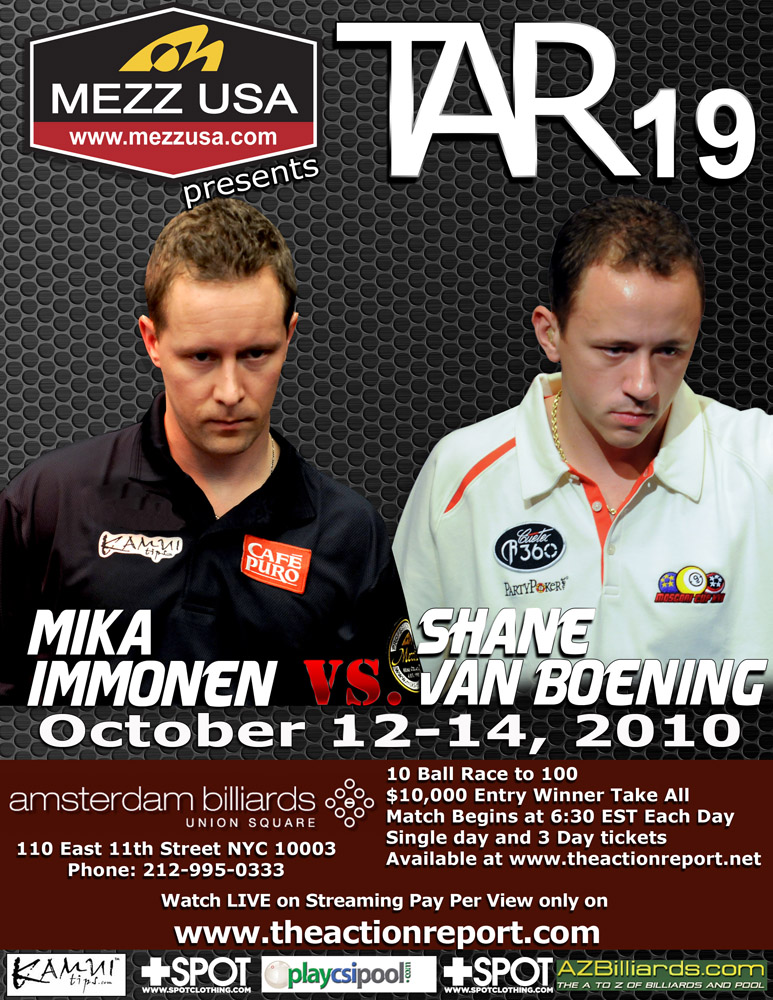
So far, slightly more fans pick Mika in Oct. 12-14 shoot-out.
So far, fans are almost evenly divided as to who they predict will win the big shoot-out Oct. 12-14 between Mika Immonen and Shane Van Boening. I threw the question out yesterday, with the promise of a free book to the person who most closely predicted the final outcome. The contest is 10-ball, race to 100. Both players have put up $10,000. Winner takes all.

Of the 23 people who immediately made predictions, 12 picked Mika and 11 picked Shane. Interestingly, however, a few said Mika would win in a blow out. One fan predicted Mika at 100 and Shane at 61 -- a 39 game difference. Averaging out the predictions of games won, I find that fans predicted that Mika would win 96.0 games and Shane would win 90.2. The larger spread in this category is attributable to those who picked Mika in a blow-out.

There's still time to enter the contest for the free book. Here's the rules: I'll send a copy of the Hustler & The Champ or Hustler Days to the person who most accurately predicts the final score. Only one prediction per person. I'll give away more than one book -- up to five, at random -- if more than one person predicts the right outcome.  To vote, simply comment at the bottom of this post with your prediction. It's easier for me if you list Mika first, his score, and then Shane, with his score. That way I won't go blind looking at all the numbers.

You can also slide over to the linked Facebook page and make your predictions there. The contest closes at 4 p.m. central time on Oct. 12, before the opening day break.  I've also created a separate online poll, at the right. The poll has nothing to do with the book contest. It's just an easy way to keep up with all the fan predictions.

A bit of background about both players: Between them Van Boening and Immonen have won the last three U.S. Opens in a row.  Many consider Van Boening America's finest player. Many consider Immonen (a native of Finland now living in New York) the greatest from Europe. Maybe the world. Both have been named Billiards Digest players of the year.

The three-day pay-per-view event is sponsored by The Action Report, AZ Billiards, CueSports International and others. I have nothing to do with this event, am not sponsoring it, nor have I been paid a dime to endorse it. However, I hope this event is successful. With the dearth of quality pool of TV, it's heartening to see creative events like this one live streamed on the web.

For more information, check out The Action Report website at theactionreport.com.

-- R.A. Dyer

Tuesday, October 5, 2010

Mika or Shane?

The Conversation from Justin Collett on Vimeo.

Just one week until the high-stakes action match between Mika Immonen and Shane Van Boening, two of the greatest players alive today. The game: 10-ball. The venue: New York City's Amsterdam Billiards. Each puts up ten grand. Winner takes all.

Between them Van Boening and Immonen have won the last three U.S. Opens in a row.  Many consider Van Boening America's finest player. Many consider Immonen (a native of Finland now living in New York) the greatest from Europe. Maybe the world. Both have been named Billiards Digest players of the year.

The three-day pay-per-view event begins Oct. 12. It's sponsored by The Action Report, AZ Billiards, CueSports International and others. I have nothing to do with this event, am not sponsoring it, nor have I been paid a dime to endorse it. I'm just geeked. So much so that I'll send a free book to the fan who most closely predicts the final tally.

I hope this event is successful. With the dearth of quality pool of TV, it's heartening to see creative events like this one live streamed on the web.

For more information, check out The Action Report website at theactionreport.com.

-- R.A. Dyer

Saturday, October 2, 2010

History of Sharking 2.1

The Alfredo De Oro Bladder Technique

De Oro
I wrote an essay sometime back in which I listed some of the most popular sharking techniques in history. Somehow I neglected to mention one of my favorites. During the 1936 World Billiards Tournament, when Alfredo De Oro was 71 years old, the Cuban master found himself matched up against the legendary Welker Cochran. Cochran was then at the top of his game.

This is was what Cochran had to say about the encounter:
 "I knew the old man would have to take six piss breaks during the game. I couldn't complain about it because of his age, and I wasn't going to let it bother me if he took a lot of time. Halfway through the game he hadn't asked for permission to leave the table and I started worrying about him. Started worrying about his bladder. After all, he still hadn't gone to the can. Was he alright? Was he going to go in his pants? Was he in pain trying to hold it back? I got so worried about his bladder I couldn't concentrate on what I was doing. That old man did not take one piss the entire game, and that's what beat me."
That anecdote was included in Robert Byrne's hilarious book, McGoorty: A Poolroom Hustler. If you haven't read the book, you should do so immediately.  It was also from Bob Byrne that I learned about another great book, The Theory and Practice of Gamesmanship, by Stephen Potter. I took many of the sharking techniques listed in my earlier post from that book.

Sharking, technically, is different from hustling. A person who sharks uses psychological warfare to distract an opponent. For instance, he might intentionally blow his nose as his opponent is shooting. A hustler employs outright deceit. The most obvious example is the player who intentionally shoots poorly in order to lure the guileless into a bigger bet.

I have never come across any evidence that Alfredo De Oro hustled pool. But it's not surprising that a man now remembered as one of the greatest in history would resort to sharking (or any other legal tactic) to win.  De Oro (1863-1948)  won more than 30 pocket billiard titles.  That's more titles than both Willie Mosconi and Ralph Greenleaf. De Oro also held the three-cushion title ten times between 1908 and 1919.

-- R.A. Dyer

Thursday, September 30, 2010

Wimpy Lassiter's World War II records

[You can also read this post and more at the poolhistory.com website]
Wimpy Lassiter spent most of World War II on one of three Coast Guard cutters, all of which operated just off Norfolk. The Navy subsumed the Coast Guard during the war, and the cutters were tasked with picking men from the burning wreckage of German u-boat attacks. By all accounts, Lassiter made for a terrible sailor. Eyewitnesses tell us that he was sick most of the time. Lassiter himself told a friend that he wanted to crawl off and die because of the motion sickness.

While researching Hustler Days I reviewed Lassiter's military records and put together a timeline. I've reproduced it below. You might come across a few of my typos here and there because this is pretty much how the timeline appeared in my raw, unedited notes. I find the entry for May 8, 1943 particularly instructive. The military records for that day indicate that Wimpy neither desired a job, nor had requested to attend a service school. This shouldn't come as a surprise, as Wimpy already was making himself rich in Norfolk. He was said to have amassed several hundred thousand dollars in pool winnings in the  pool halls during these years -- and remember, this was the 1940s. Under such circumstances, why would he want to attend a service school?

Lassiter would go on to win eight major 14.1 titles during the 1960s -- and that's not counting his four straight pool victories at Johnston City. He also picked up five nine ball championships in Johnston City, a Johnston City one-pocket victory, and he won the Johnston City all-around championship five times.

I've also posted this time line of his early years in my separate Wimpy Lassiter blog. You can find it here.


Total time in Service: Three years, 10 months, and 7 days.
Spent time aboard vessels: CG 83511, CG 74307, CG 74306


September 1934 - Dec. 14, 1937
Attended high school. In letter by Edgar E. Bundy, Superintendent of Schools to recruiting board, Wimpy was said to have left school for work.

1938-1940
Employed by J.C. Connery, Burgess Street, Grocer man (according to Coast Guard application), drinks intoxicating liquors on ``rare occasion,’’ never convicted of crime.

April 2, 1941
Walks into recruiting station, Norfolk, to sign up. Signs special temporary enlistment contract. Employment was shown as clerk; enlisted or three years; described as 22 years old, 5’10’’, weighing 136.5, with blue eyes, black hair, fair complexion,

April 22, 1941
Receives physical examination that reports: 20-20 vision, not color blind, hearing normal, height 70 inches, weight 136.5 pounds, chest (exhale) 34; (inhale) 31 pulse before exercise 84, after exercise 100, after three minutes 84. Tonsillectomy, 1931. Age 22 years, 6 months.

April 25, 1941
A form he fills out shows no experience in any trade.

May 1, 1941
Accepted for service in Norfolk, VA. Receives clothing bounty pay of $112.75 Immediately transferred (at 2:30 p.m. that day) to Curtis Bay, Maryland for training.

May 1, 1941
In designation of Beneficiaries for Death Gratuity, names mom, Florence L. Lassiter as beneficiary. No mention of dad. Signed by recruiting officer.

Aug. 12, 1941
Requests transfer to Elizabeth City, where Wimpy understands vacancies exist in Seaman branch.

Aug. 27, 1941
Transfer denied.

Sept. 1, 1941
Advance from rating from Seaman to Seaman second class.

Dec. 2, 1941 (1730)
Depart for temporary duty, course of instruction at the Internal Combustion Engine School, Norfolk, upon completion report to the senior Coast Guard officer, Fifth Naval District, for assignment.


Dec. 3, 1941-Feb. 14, 1942
Class assembles. Names of classmates listed in records. Special qualifications record shows:
"Norfolk training station, 2-14-42, completed operators’ course in Internal Combustion Engines, with a final mark of 76.3 or 3.1, 43rd in a class of 45 men."

Dec. 6, 1941
World War II begins.

Feb. 21, 1942
Transfer to CG-140 (There is some uncertainty on this entry).

Nov. 17, 1942
Also shows him aboard CG 73406.

March 21, 1942-Nov. 20, 1944
Transfer to CG 74306.

June 8, 1942
Raises in rank to Ffc (something first class -- uncertainty on this entry).

March 15, 1942
Landing party boat training, New River, N.C..

Nov. 17, 1942
Promoted to machinist mate second class.

May 31, 1943
Becomes machinist mate first class.

July 31 1943
Trains on Camp Glen Rifle Range, receives expert rifleman’s medal on 14 Aug. 1943.

April 30, 1944
Enlistment involuntarily extended for the duration of war, plus six months.
Vessel Designation: CG 74307, at CG base: 05-013.

May 1, 1944
Enlistment involuntarily extended for duration of war, plus six months.


May 8, 1943
Coast Guard Enlisted Qualification Card Shows: 7 years grammar school, ending in 1931; three years High School, ending in 1934 (which means six years of playing pool before the service), And Grades of 80 in social studies, 66 in Arithmetic, and 79 in Mechanical aptitude. Shows no service schools qualified for, and no service schools desired. Weight then: 158 pounds. Main occupation: no jobs.
Says: "No jobs, no service schools desired."


Nov. 7, 1944 (1145) -Nov. 24, 1944
Received inpatient treatment for Pyelonephritis. Vessel designation CG-74306.

Nov. 20, 1944-Nov. 29, 44
Aboard CG 74306.

Nov. 29, 1944 through Sept. 12, 1945
Stationed aboard CG 74307.

Sept. 12, 1945
On leave, from vessel CG 74307.

Sept 16, 1945
Transferred to CG 83511 for duty, CG Patrol Base, Municipal Pier, Norfolk, VA; apparently from CG 74307.

Oct. 1, 1945
Letter from J.I. Crews states: "Lassiter ... has completed a continuous period of three years’ active service on 4 April, 1944, with no mark in conduct of less than 4.0. Accordingly, appropriate entry has been made of the service record and above named man has been authorized to wear appropriate (ribbon) in lieu of issue of actual award at this time."

Oct. 10, 1945
1300 hours, letter addressed to Wimpy in Norfolk, Virginia says, "Proceed to: Portsmouth, Virginia, CO.CG Personnel Separation Center, No. 5, Crawford Street. Discharge from the Coast Guard on Draft No. Nornor-56."


October 11, 1945
Discharge papers show that he weighs 161 pounds. Apparently gained 25 pounds in the service (up from 136.5 pounds).

October 12, 1945
Discharged in service


-- R.A. Dyer

Monday, September 27, 2010

The Mail Bag: Ames, Allingers & Mosconi


For my recent Pool Synergy contribution, I wrote about Willie Mosconi, The Hustler (for which Mosconi served as a technical advisor) and the contents of the billiard legend's pool case. One of the items that I described was a neatly folded piece of paper that contained a list of shots, apparently from Willie's trick shot routine. But reader Erling Hammarstrom, in a letter from Sept. 26,  said he had watched Mosconi in a number of exhibitions, and that the shots described in the note do not match those that he remembers.

Hammarstrom also has an interesting memory of the Ames' pool hall, in New York City. Here's what Hammarstrom has to say:

"I had the opportunity to see Onofrio Lauri and Mosconi play in a number of exhibition matches. In reviewing the list of trick shots it appears that they are not all the shots that Mosconi would use after an  exhibition. Shot number 15 with the three cues was Lauri's signature shot. Mosconi always completed his trick shots with the long masse. Mosconi would stroke down on the cue ball sending it three quarters of the length of the table before the english took and it spun back making a ball in the corner pocket. 

My favorite Mosconi shot was when he would roll a ball down the table and hit it with the cue ball making the object ball in the corner pocket. He would do this a couple of times and then said, lets make it a little more difficult. He would put two balls,one on either side of the corner pocket so that you could barely pass a ball in between them. He then rolled a ball down the table, hit it with the cue ball and knocked it cleanly in between the two balls guarding the pocket. He was incredibly accurate. 

Speaking of Mosconi I bumped into him at the entrance to Ames Billiard Academy. He told me that the place was closed because they were making a movie. I mentioned to him that I had seen him play Jackie Gleason on television recently and did he hold back so he wouldn't beat him too badly. He said no. Gleason was a real good pool player capable of running a hundred balls. The movie they were filming was the Hustler. Needless to say I tried to get in the movie as an extra to no avail."

And speaking of famous pool halls that begin with the letter "A,"  reader Michael McCafferty, author of the Diary of a Pool Shooter blog, sends in his recollections of the famous Allingers in Philadelphia. I had written about the pool hall in a Sept. 12 blog post, after a reader had sent me copies of some photos that had hung from its walls. Here's McCafferty's note:

"I remember Allingers! I played there a few time in the late '50s, early '60s, when I was still in school.

It was on the second floor, but since whatever was on the first floor had really high ceilings, the climb up the stairs to Allingers was long and narrow, and it wasn't unusual to pass a few bums hiding out from the weather.

Inside, right in front of the counter, was the main action table, with a prominent sign proclaiming 'NO GAMBLING', but of course that was just for show.

The floors were all bare wood planks, and I remember that the place wasn't a high example of cleanliness, but there seemed to be a high degree of orderliness.

The strongest memory I have of Allingers was the rack girls. You could rack your own, of course, but if you could also get help. Bang your stick on the floor a couple of times, yell 'RACK!' and a little black girl would scurry over and rack 'em for you, for tips. I remember the going rate was a dime a rack, pretty good money in those days.

Allingers was a Philly landmark, the high holy place of pool south of New York City.

When I graduated from college and started working for a living, pool left my life for 40 years, during which time Allingers quietly closed up forever."

Tuesday, September 21, 2010

Billiards Mystery from a Baseball Historian*


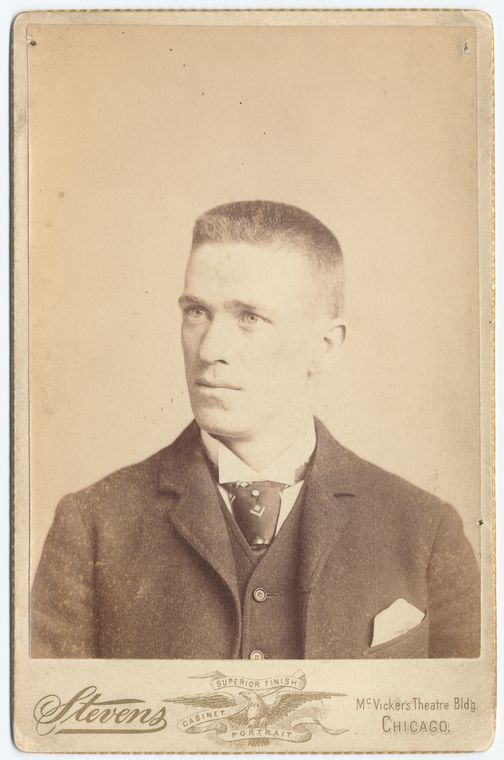
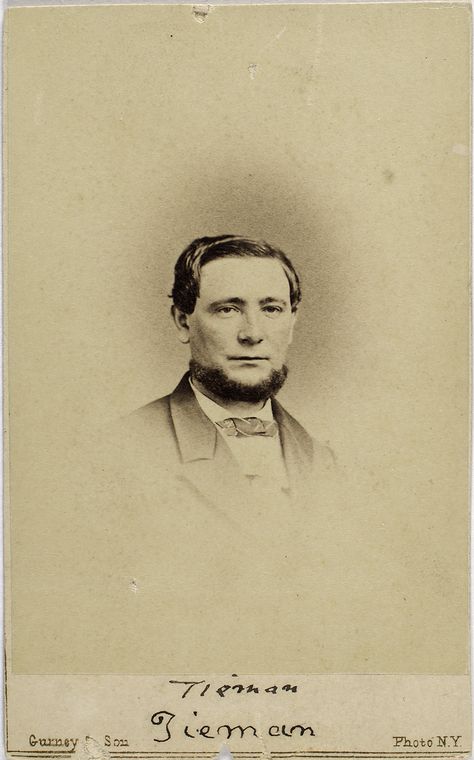
Two photos. One mystery. The man with the crew cut on the right is Mike Tiernan, a famous 19th Century outfielder. But who is the bearded fellow on the left?

Baseball historian Tom Shieber, the man behind the Baseball Researcher blog, recently stumbled across these two photos in the  digital archives of the New York Public Library.  Tiernan was identified as the man in both photos. According to Shieber, Tiernan was a famous player during his day, having amassed 1,838 hits and 428 stolen bases with the New York Giants between 1887 and 1899.

But how could these photos be of the same person? The images appear so obviously different. Shieber looked more closely at the photograph on the left and found on the back the name of a photo studio. Through a little sleuthing, Shieber discovered the studio was not even in existence when Tiernan was playing for the Giants. Even closer inspection revealed that the name printed on the front wasn't "Tiernan," but rather "Tieman."

What the baseball historian had stumbled across was not a photo of a famous 19th Century baseball star, but rather a famous 19th Century billiards player. The image on the left is that of Philip Tieman, who competed in some of this country's earliest national tournaments. The image was misfiled in the archives.

Pool occupied a very different place in the public consciousness during the 19th Century. It was a sport that was then growing in popularity -- so much so that it would even vie with baseball for the public's attention.  Tieman matched up against some of pool's earliest stars, including the man now remembered as the Father of American Pool: Michael Phelan.  In 1865, for instance, the two men competed in an exhibition in Ohio. According to the New York Times account:  "The players took special pains to make intricate and general display shots, and their efforts being crowned with unusual success, and the audience being a highly appreciative one, rendered the affair brilliant in the extreme."

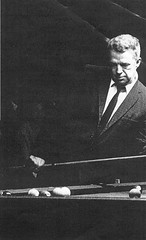
The match was won by Phelan, a man now famous for having also won the first national billiards stakes match, for being the first to place diamonds on pool tables, and for authoring the first American book about billiards. That's a picture of Phelan just below, at the left.  He was inducted into the Billiard Congress Hall of Fame in 1993.


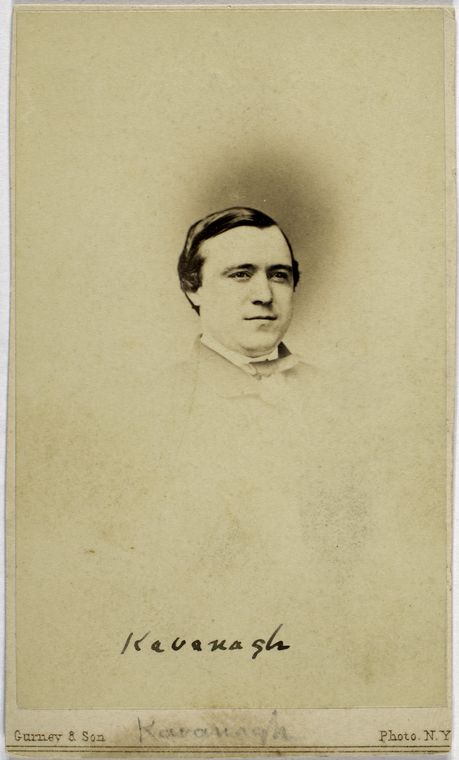
In 1864, Tieman matched up with Dudley Kavanaugh in Irving Hall in New York. The Times described it as the most anticipated pool match in the nation.  There was a packed house for the event. Unfortunately
Tieman was "much afflicted with rheumatism" and not in top-notch shape. "Although he was in fair health on his arrival yesteday morning, his left wrist was much swollen and he complained of considerable pain," the newspaper reported. Kavanagh won 150 to 98. That's a picture of Kavanagh on the right.

I consulted Mike Shamos, curator of the Billiards Archives, about Shieber's find.  Mike was very much excited about it and confirmed that a separate image in the Archives confirms the baseball historian's discovery.


-- R.A. Dyer

Wednesday, September 15, 2010

Pool Synergy 11: What's in Mosconi's Case?


Consider exhibit A, above. It's a handwritten note in which someone has enumerated 13 pool shots, each of which has been described with just a few words. The unnamed author uses cursive letters that slant off to the right. It also looks like he took his time writing it because the script is deliberate. Almost tidy. And judging from the crease marks, one can assume the note was at one time folded into at least three sections. This tells me that the unnamed author must have been carrying the note around with him. 

Why are we examining this note? Because at one time it may have resided in the pool case of one William Joseph Mosconi, the 15-time world champion. I recently found it in the Archives Center of the  National Museum of American History in Washington. As part of my contribution this month to the  PoolSynergy project, I'm posting this note up here.

Quick review: Pool Synergy is a monthly collaborative effort in which online pool writers take on a single theme. This month it's pool gear. Our September host, Samm Diep of pooltipjar.com,  has asked us to provide photos and descriptions of stuff we put in our cases. But as I write about history here, I decided not to explore my own gear, but rather that of Willie Mosconi.

Many consider Mosconi to be the greatest player of all time. He was born in 1913, went on to win numerous world championships, was inducted into the Billiard Congress Hall of Fame, hobnobbed with the rich and famous.  This yellowed note, pictured above, was written by Mosconi sometime in the 1960s. It  includes a description  of the “Paul Newman” shot, an apparent reference to the shot the actor employed in The Hustler. Mosconi, as you may recall, was a technical adviser for the film and,   according to information on the Archive's website, these notes relate to shots employed in the movie. That could be. But it also could spell out Willie's exhibition trick shot routine, which doubtlessly also included the Paul Newman shot.

The Archives Center also possesses other objects that Willie doubtlessly carried in his case. I don’t have images of them here, but there are business cards and letters. The archives also possess several items that wouldn’t fit in Willie’s case, including scrapbooks, legal records, videos of Mosconi's appearance on the Ed Sullivan show and the affidavit attesting to his famous 526-ball straight pool run.

Now consider exhibit B, the simple piece of chalk pictured just above. Although you can’t tell it from this photo, this piece of chalk once rested on the rail of Willie Mosconi’s pool table in the basement of his Haddon Heights home. Flora Mosconi, Willie’s widow, gave it to me some years back.  The piece of chalk is not autographed or otherwise marked to signal its famous origins. But I know the truth. It looks well worn. But was it ever in Willie's case? You be the judge.


Sunday, September 12, 2010

Allingers Pool Room Photo Mystery


That's a picture, above, of the famous Allinger's Billiard Academy as it appeared in 1910.  I found the picture at the 3cushion.com website. The greatest players in the world made their way to Allingers, including Greenleaf and Mosconi. I believed the room may have moved around during its tenure -- folks from Philadelphia would know better. At any rate, in the 1950s it was located at 1307 Market Street. It was at this location in 1954 that Wimpy Lassiter won his first national championship. He defeated defeated Irving Crane 150 to 130 in the final. (You can read about it in Hustler Days).

Why am I writing about Allingers? Because reader Jason McManus recently sent me some photos that once hung on the walls of the poolroom. He explains that these are reproductions -- that is, they're photos of photos. That's why you can see the flash in many of them. 

Jason said he didn't take the photos himself, but rather they were taken by his friend Joe. "I remember Joe telling me a funny story of how he learned the game of pool there from the older guys.  They sort of babysat him, as he was supposed to go to the dentist.  What Joe did not know was that his mother gave them passes for a burlesque show where his mother was a makeup artist."

I can imagine a lot of these guys appreciating tickets to the girly shows. Jason wonders about the identities of these pool players. Anybody have any clues?  The guy right below looks to be Hubert "Daddy Warbucks" Cokes, the famous gambler and one-pocket player. Also: who has more stories about Allingers?

-- R.A. Dyer

Saturday, September 4, 2010

RIP Frank McGown, New York Pool Legend

Frank McGown is dead.  I know this because I recently stumbled across a short obit for McGown during my semi-regular trolling of the Internet for pool news. The story I found in the Billings Gazette notes that "over the years, Frank won many billiards honors."

Just to be clear: Frank W. McGown was a former New York state champion who, during the course of his career, beat Wimpy Lassiter, Onofrio Lauri, Harold Worst, Mike Euphemia and Lou Butera. He was a regularly top finisher in world competition, and once ran 150 and out against Joe "Meatman" Balsis. Although the reference to his billiards success doesn't appear in his obit until somewhere near the middle, it should be noted that at one time, Frank was a very big deal. For our sport, his loss is a great one.

I first came across McGown's name some years back while researching Hustler Days, my book about Lassiter and the 1960s pool renaissance.  In '67, during the early going of that year's Billiard Room Proprietors Association of America world tournament, McGown demolished Wimpy 150-22. As was McGown's custom, he played excruciatingly slow. Other players hated matching up with him.  "Now, lawdie, I ask you sir, wasn't that awful?" Lassiter said shortly afterwards. "Why that danged rascal McGown played a real slow-down on me, he did indeed."

McGown ended up finishing 6th in that tournament, and then finished third the following year. It was during that 1968 event that McGown ran 150 and out against Balsis. In an article from the March 1983 edition of Billiards Digest (which you can find here) McGown recounts how he made a stunning shot to complete the run. Balsis had scratched of the break, giving McGown ball in hand. "I got up and ran 149 balls, and then got tied up," wrote McGown.  He had to resort to a tricky cross-corner bank to complete the run. That's a diagram of the shot, above.

Lou Figueroa also posted up a funny recollection on the players' forum at azbilliards.com. Lou had matched up with Frank during an exhibition. Lou said he was playing well, and thought he had the nuts to win.
"I start to run the balls. I get into the second rack. And then the third. Frank goes to the bathroom. I get into the fourth rack. The balls are wide open. And then comes the shot that I still remember today: a little baby two ball combination on the rail behind the rack that, as Danny McGoorty would have said, a drunk Girl Scout could've made if you held her up to the table long enough.
And I took it for granted and I hung up the ball.
I was told afterwards, by a friend who went into the bathroom at that point, that McGowan was in there washing his hands. When my buddy told him that I had just missed, McGown went, 'He missed?!' And McGown comes flying out and quickly proceeds to make a dish of Shredded Duck ala Lou with an 80-something run and then a 50-something."
A few quick biographical notes.  McGown was born on Sept. 27, 1933 in Brooklyn.  He worked as an accountant in New York, and then served with the U.S. Army in Germany until 1958.  He returned to accounting upon his return from Europe, but eventually left that profession to go into business for himself.

He partnered with the dad of pool legend Jean Balukas in the operation of a Brooklyn poolroom  during the 1960s. He also competed in various national and world events. According to Charlie Ursitti's site, McGown had top ten showings during major competitions in 1963, 1964, 1965, 1966, 1967 and 1968.

McGown eventually moved to Montana, where he at one time managed a chain of pool rooms. He died in Billings on Aug. 20th after a stroke and long illness.

Rest in Peace, Frank McGown.


-- R.A. Dyer