Saturday, February 26, 2011

Rule 16: Do Not Ask to Play Dippy Dave Even


Dippy Dave, also known as David Peat, was awarded the Louie Roberts Action and Entertainment Award at this year's Derby City Classic.  I watched him in high-stakes action against Sylver Ochoa, of Houston, in The Action Report room. It was very late on the last Friday of the tournament. Sylver was giving Dave a giant spot -- 16-4 as I recall. The game was one-pocket. Dave lost.

But the Louie Roberts Award is not awarded for winning in the action room. It's awarded for entertaining in the action room. And on this score, Dave was without peer. He's funny, he demands ludicrous spots, and he's got heart. He can't play like the top pros, not even close. But he's willing to challenge them for humongous stakes. Dippy Dave won the Louie Roberts award in a landslide.
Rule No. 16: Do Not Ask To Play Dippy Dave Even.

Dave hails from the world of professional poker, and, according to his online bio, has tallied up more than $270,000 in tournament earnings playing Texas Hold 'Em. He started playing in high-dollar pool matches last year, mostly one-pocket. Although he lost a small fortune early on, Action Report founder Justin Collett tells me that Dave lately has booked some winners -- including sticking one of the great Filipino players not long ago for $80,000 and a former U.S. Open winner for $40,000.


"Dippy is a stone hustler," Collett said. "If he's playing a couple a hundred a game, he don't give a ****. He would rather have a good time, and make everybody laugh. When he was playing Sylver at the Derby, they were playing cheap, a couple of thousand, and I know that Dippy was not going to win those games."

"But Dippy has a tremendous amount of knowledge about the game. I've seen him win games against Alex (Pagulayan) or Gabe (Owen) when it got down to two balls on the table. Or even just one ball. Getting that sort of weight, he's not supposed to have a prayer."

That's a video of Dippy Dave, above, playing Scott Frost. It was shot prior to Derby City. I found it on YouTube. Last year's Louie Roberts Award went to Jeanette Lee.

-- R.A. Dyer

Tuesday, February 22, 2011

Black History Month

The Late Great Cisero Murphy

Since we're all about history here, and this month is Black History Month, I figured it's important to commemorate today one of this nation's all-time great African American pool players. Cisero Murphy, shown in the video that you can find here, was the first African-American pool player to ever win a World or U.S. National billiard title. Murphy also was a trailblazer for equal access, having to overcome prejudice to gain his right to compete at the very top echelon of pool.


A native of Brooklyn, Murphy was born in 1937. He was one of eight children. He took up the sport early, dropped out of high school at age 15 and then a year later won the city pool championship. He won the state championship in 1958. 

But because of his race, Murphy was excluded from world and national competition, including the Billiard Room Proprietor's Association of America events in New York and major tournaments in California. Finally, after pickets in both states, Murphy was invited in 1965 to compete in the World Invitation 14.1 tournament in Burbank California. He won it convincingly after defeating Luther Lassiter in the finals. With his victory, Murphy became the first pool player ever to win a world title in his first attempt. The BRPAA would also relent, inviting Murphy to compete in the organization's tournaments in New York. This effectively ended all official race-based barriers to entry in major professional pool tournaments.

Through the years Murphy would play and defeat many of the other greats, including his friend Jersey Red and even Willie Mosconi himself. He continued to place near the top in straight pool events during the 1960s and, according to the Billiard Congress of America website, posted several competitive high runs of over 250 balls.

Murphy was inducted into the BCA Hall of Fame in 1995. He died the next year.

-- R.A. Dyer

Monday, February 14, 2011

PoolSynergy 16: Favorite Pool Halls

The famous Allinger's Billiard Academy as it appeared in 1910.  The greatest players in the world made their way to Allingers, including Greenleaf and Mosconi. I believed the room may have moved around during its tenure but in the 1950s it was located at 1307 Market Street in Philadelphia. It was at this location in 1954 that Wimpy Lassiter won his first national championship. He defeated defeated Irving Crane 150 to 130 in the final.
Pool halls. Everyone has a favorite. I was partial myself to Houston's Cue & Cushion and Costa Rica's Center Pool. Both now are defunct. For my contribution this month to PoolSynergy (the monthly online collection of pool essays) I've reproduced a number of letters I've received over the years about favorite pool halls. Some of these rooms were stately. Others decrepit. But all, in their way, important. 

At the end I've included my own short essay about Cue & Cushion. Also, here's a link to a Billiards Digest column about Fort Worth's Fast Freddy's. It's said to be haunted by the ghost of U.J. Puckett.

St. Elmos, Norfolk, Virginia,  Ken McCarthy
"When I was in the navy (1961-1965) I was stationed in Norfolk ,VA and played pool every minute I had at St. Elmos pool hall (2nd floor, a few buildings up from the YMCA). As you know this is where Wimpy played when in town, and it is where I saw him ( I still have a perfect vision of that white head standing out in the dimness along the left wall watching the goings-on). I was just starting to play pool and my friend pointed him out to me as a great player, although at the time I really didn't realize HOW great a player.

"In 1963 or 64 I bought a Willie Hoppe special (Brunswick) cue through the owner (a kindly, short, bald-headed man). I then sanded off a section on the top of the butt, bought a Parker ink pen and asked Mr. Lassiter to sign it. He did, and I still have the cue and the pen. I have recently picked up the game again and I now know that he was actually at the top of his game when he signed my cue!"


Allingers, Philadelphia, Michael McCafferty
"I remember Allingers! I played there a few time in the late '50s, early '60s, when I was still in school. It was on the second floor, but since whatever was on the first floor had really high ceilings, the climb up the stairs to Allingers was long and narrow, and it wasn't unusual to pass a few bums hiding out from the weather.

Inside, right in front of the counter, was the main action table, with a prominent sign proclaiming 'NO GAMBLING', but of course that was just for show.

The floors were all bare wood planks, and I remember that the place wasn't a high example of cleanliness, but there seemed to be a high degree of orderliness.

The strongest memory I have of Allingers was the rack girls. You could rack your own, of course, but if you could also get help. Bang your stick on the floor a couple of times, yell 'RACK!' and a little black girl would scurry over and rack 'em for you, for tips. I remember the going rate was a dime a rack, pretty good money in those days.

Allingers was a Philly landmark, the high holy place of pool south of New York City.

When I graduated from college and started working for a living, pool left my life for 40 years, during which time Allingers quietly closed up forever."

Allingers, Philadelphia, Rayna Polksy
"My Grandfather, Sam Ross, owned Allingers probably from about 1945 until it closed. The business was managed by Sam Ross and his family: Martin Ross, Louis Ross, Jerry Ross, Jay Ross and my father, Irving Polsky. In addition to helping to manage the place , my father did most of the repairs and maintenance of the billiard tables. In addition he made cue sticks. Many of the famous players came to Allingers: Willie Hoppe and Willie Mosconi for example. My dad would bring me to Allingers on the weekends and teach me how to shoot pocket billiards. Unfortunately, I never had much talent for playing pool." 

Texas Recreation, Fort Worth,Texas, Big Daddy
 “When I was a teen-ager in Fort Worth, I had an uncle who introduced me to Texas Recreation in downtown Fort Worth. This was an open-bay pool room with dozens of table where you played for 60 cents an hour. I came back later when I was 16 and 17 and hustled pool there. Ask around, old timers probably remember the pool hall.

 It was located in downtown Fort Worth on Houston Street on the second floor over a burlesque house. The burlesque place had photos of dancers in glass frames on the walls in front of the place. These were girls with feather boas wrapped around their waists and chests. I never went upstairs before checking out the photos of the dancers that week. Right next door to the burlesque house was Peters Bros. Hat stores, which has been fitting cowboy hats since 1933 at the same location. It is still there.”

Cue & Cushion, Houston, Texas, R.A. Dyer
“It was a great pool hall, having been a favorite haunt of Jersey Red, John "Duke" Dowell, Texas Bob and a cast of colorful others. I remember watching when guys like Corey Deuel and Jeremy Jones strolled in, looking to make games. Both are former U.S. Open 9-ball winners. There have been plenty of others, too -- even world-class players from overseas -- and so it was always wise to know who was who and what was what when you were invited to play for money at the Cue & Cushion.

Such big-time players always drew spectators -- the railbirds, they called them -- and these railbirds would crowd around the end of the tables, sometimes balancing on their heels to afford themselves a better view of the action. The out-of-town professionals would match up with the local hotshots, and the local hotshots would ask for a "spot," or handicap, to make the games more even.

When you asked for a table at the Cue & Cushion the bartender would mentally size you up and then you'd be sent off to play on one side of the L-shaped room or the other. The regulars would invariably go to the tables on the south side, while the casual players would go to the west.

It was there where I first met the great Jersey Red, remembered today as one of the greatest one-pocket players in history. Red could give away giant, ridiculous handicaps at this variation of pool (in one-pocket, you must sink all your balls into a single pocket) and still come away with the cash. Before his death of cancer in 1998, Red was a fixture at the Cue & Cushion. It was also at the Cue & Cushion where I picked up stories about other legends -- of men like Greg "Big Train" Stephens, for instance, who once ran 11 racks consecutively playing nine-ball against Wimpy Lassiter, or of the great Willie Mosconi, who could run 60 and 70 balls as easily as us mere mortals would run three or four. The old-timers at the Cue & Cushion were actually eyewitnesses to these events. For the price of a beer, they'd eagerly regale you with these stories and more.

With its demise, Houston has lost a small connection with its colorful past.”

About PoolSynergy
Pool Synergy is an online collaborative effort by pool and billiard bloggers, in which each agrees to write about a single theme. PoolSynergy submissions are published simultaneously by each of the participating blogs on the 15th of every month. To read a list of the other fine contributions this month, check out the Confessions of G Squared blog, which you can find here.


-- R.A. Dyer

Sunday, February 6, 2011

Pearl mounts comeback, SVB takes cheese


SVB with his big checks for winning the DCC
Earl Strickland had a great run during this year's Derby City Classic. He placed high in the nine-ball field, and only fell a few balls short of winning the One-Pocket division outright. He beat Shannon "The Cannon" Daulton in the semi-finals (3-2 in a close match), and then narrowly lost to Shane Van Boening in the finals 2-3.  The Pearl expresses a few choice words after his One-Pocket defeat in the video above.

Van Boening went on to place second in the nine-ball division and took the Master of the Table award.  Dennis Orcollo won the nine-ball division (check out the video in the blog post below). Alex Pagulayan won the Nine-Ball Banks division, and placed second in the Straight Pool Challenge.  The Straight Pool Challenge went to Darren Appleton.  Rodney "The Rocket" Morris won the Fatboy 10-ball challenge, beating out Appleton in the final.

If you're trying to keep up, here's the list:

Derby City Classic, 2011

Master of the Table: Shane Van Boening
Nine-Ball: Dennis Orcollo (Second: Shane Van Boening)
One-Pocket: Shane Van Boening (Second: Earl Strickland)
Nine-Ball Banks: Alex Pagulayan
Fatboy 10-Ball Challenge: Rodney Morris (Second: Darren Appleton)
Straight Pool Challenge: Darren Appleton (Second: Niels Feijen)

-- R.A. Dyer

Saturday, February 5, 2011

Orcollo's Last 9-ball Run Out at Derby City


Dennis Orcollo, left, and Lee Van Corteza
Dennis Orcollo was nearly unstoppable in nine-ball at Derby City this year. His only defeat during the entire event was to fellow Filipino Warren Kiamco -- and even then Orcollo shined. Kiamco had Orcollo way down and Kiamco was on the hill when Orcollo came roaring back to within one game of victory. Orcollo also ran over Mika Immonen and, as you can see in the video above, the great Shane Van Boening. Orcollo beat SVB in the nine-ball final 7-1. The video above shows Orcollo's last run-out. Fantastically, Orcollo jumped out to a 5-0 lead in the match after Shane left a shot in the first game. Orcollo finished that rack and then broke and ran four more.  I also saw Orcollo in action at Derby City giving Chris Bartram the 8 and the 10, playing 10-ball in a race to 30. I think they were wagering $3,000. Bartram, one of the nation's great road players, got the worst of it. The exchange made a believer out of me about Dennis Orcollo.

-- R.A. Dyer

Sunday, January 23, 2011

Boston Shorty versus Harold Worst


Boston Shorty, four-time winner of the Johnston City One-Pocket competition,  is remembered as one of the greatest one-pocket players ever. Harold Worst won the 1965 Johnston City tournament outright, as well as that year's Stardust Open. Worst could have been remembered as the most dominant player of the 1960s if not for his premature death (at age 37) from cancer.

You can watch the two legendary players battling it out in the video above. I really love the groovy jazz music in the background. Very atmospheric. And if you want to learn more, there's also Hustler Days. The book includes information about the famous Johnston City  tournaments, Worst's dominant play in 1965, and a reference to Jersey Red's travels with Boston Shorty. Freddy "The Beard" Bentivegna also has a link to a Jim McKay interview with Worst, which you can find here.

Saturday, January 15, 2011

PoolSynergy 15: Earl, Willie and Team Pool


In the youtube video, above, Earl "The Pearl" Strickland illustrates why some believe pool should remain an individual endeavor. It was taken during the 2006 Mosconi Cup, conducted in the Netherlands.  Judging from the video, it appears that Earl's cue did not simply break, but actually exploded. I love the obnoxious air horns, the wiseacre heckler. I can't speak Dutch, but I imagine he's congratulating Strickland for a job well done.

Phoning it in
For this month's edition of PoolSynergy, we've been asked to write about pool as a team sport. I have to confess that I do not play pool as a team sport, and so have few ideas on the topic and no over-arching theme this month. In other words, I'm phoning it in. That's a picture of me doing so, at right.

I do, however, have two unrelated observations -- one from me, and one from Hall of Fame player Nick Varner.

Willie Mosconi: team player?
First Observation: Let's talk about the Mosconi Cup. It's a great event. I find it ironic, however, that what must be considered the most high-profile team event in pool is named for a man who, like Strickland, did not always play well with others. William Joseph Mosconi, one of the greatest players in the history of our sport, was famously moody, a man with little patience for fools. Mosconi would stomp about during tournaments, chastise overly loud audience members and once allegedly attacked a tournament promoter. But boy could Willie play.

Would you want him on your team? And how about Ralph Greenleaf? The legendary player was drunk more often than not. His out-of-control antics even led to an eventual ban from tournament play. Mosconi and Greenleaf played at least two exhibition tours together, but, as far as I know, were never teammates in competition.

Nick Varner
Second Observation (from Nick Varner): As you may recall, I asked Nick some time back about his ideas for fixing pool. The Hall of Famer is the first man in history to win back-to-back titles in the U.S. Open. He's been playing and promoting the sport for years. Varner said one key to future success could be team play. He imagined the possibility of a domestic tour, but with groups of players representing individual U.S. cities or states. In the Mosconi Cup, it's the U.S. versus Europe. With Varner's idea, it would be Texas versus New York, or Los Angeles versus Cleveland.

Varner calls the Mosconi Cup one of pool's most exciting events. He has participated both as a player and as the U.S. team captain. "To really make this game (successful) we need to figure out how it could be economically feasible to have teams like in the NBA or the NFL," he said. "We could have state teams. This creates a geographic fan base. Right now there isn't a whole lot of team stuff going on. But with a Georgia team versus Florida, say, that automatically hits us like a college sport. This (attracts) the sports fan."

Part of Earl's Strategy All Along?
And finally, a note about the video, above. After his assault on that poor defenseless cue,  Earl went on to win his match against Team Europe player Thomas Engert by a score of 7-4. The event that year ended in a 12-12 tie, a good enough showing for the Americans to retain possession of the Mosconi Cup.  It was the only recorded tie in the history of the event.

With Earl on the Mosconi Cup team, the Americans have amassed a record of nine wins, three losses and one tie.  Two of those three losses and the tie came after 2006, well after Earl's heyday as a player. Without Earl, the Americans have amassed a piddling record of two and two.

What does this tell me? First, that during Strickland's heyday the Americans were nearly unstoppable. Of course it's true that teammates like Johnny Archer and Corey Deuel had something to do with the team's winning ways. But it's hard to argue with the Americans' success during Earl's glory years.

Therefore I conclude that when Earl is at the top of his game, you want him on your side. Antics or not, The Pearl wins games. If I could create a dream team, I'd also want Willie Mosconi and Ralph Greenleaf. Imagine the mayhem! Imagine the chaos!

What do you think?

About PoolSynergy

Pool Synergy is an online collaborative effort by pool and billiard bloggers, in which each agrees to write about a single theme. PoolSynergy submissions are published simultaneously by each of the participating blogs on the 15th of every month. To read a list of the other fine contributions this month, check out the Kicks, Banks, Caroms and Combos blog, which you can find here.

Friday, January 14, 2011

Is Efren Reyes Ready To Retire?

The Magician Skips This Year's Derby City Classic
Is Efren Reyes getting ready to retire? It's starting to look like that day might not be far off. A Filipino publication recently quoted Reyes as saying his showing in this year's Derby City Classic would help him decide.  “There’s a 50-50 chance (that I may retire next year),” he told the publication, The Manila Bulletin, in November.

But then, just two days ago, the same publication reported that Reyes is dropping out completely from Derby City. The famous Woodstock of Pool begins next week, on Jan. 21st. Reyes consistently has dominated it, having been declared Master of the Table in 1999, 2004, 2005, 2007 and last year -- more than any man living.

The legendary "Bata" cites chronic back pain and his failing eye sight for his decision to skip this year's DCC. He also said he's "losing his touch." When asked if the DCC decision also meant he was retiring, Reyes replied: "Hindi pa naman I think kaya pa." As near as I can figure, that enigmatic combination of Tagalog and English means "not yet, I still think so."

I'm guessing that what Bata is suggesting here is that he feels like he still has some gas left in the tank. And I would certainly agree. After all, he won last year's Derby City 8-ball division, won the Fatboy Challenge, and placed second in the banks division. He also won the Spanish Open in 2010 and the Predator International 10-ball event. According to AZbilliards, only Darren Appleton collected more in in prize money.

It's incredible to me that Reyes is even contemplating retirement. I understand that he's just a few years shy of his 60th birthday, but for my money he's still the greatest one-pocket player alive. It will be a sad day when the Magician finally hangs up his cue.

-- R.A. Dyer

Wednesday, January 12, 2011

Untold Stories in Billiards Digest

Alfredo De Oro's controversial return to Cuba

Before the age of Mosconi, before even Ralph Greenleaf: there was Alfredo De Oro, the Cuban-born legend. De Oro won his first pocket billiards crown in 1887 and then went on to win it 31 more times. He was also the only person in history to simultaneously have held both the pool and billiards crowns on two separate occasions. 

During his heyday, De Oro was considered the best cue sports player in the world. Some still say he is the greatest ever.

In the January edition of Billiards Digest, I write about De Oro's glorious return to Cuba in 1918 for a world three-cushion championship. Held in one of the nation's finest theaters and attended by the president himself, that three-day competition is  remembered today as one of the most dramatic ever in three-cushion billiards. But it also ended in controversy and bitterness.


You can read all about it in my Untold Stories column this month, which you can find here. There also also links to previous Untold Stories columns at the Billiards Digest website.


Friday, January 7, 2011

Mosconi and Greenleaf -- TOGETHER

Billiard Champs Entertain The Troops


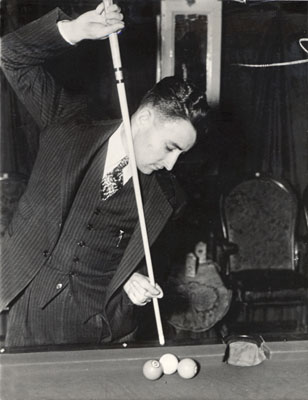
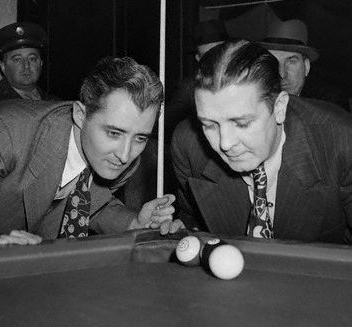
Will the wonders of the Internet never cease? I just came across this very cool footage of legends Willie Mosconi and Ralph Greenleaf sharing an exhibition stage.  (Click here to see it.) Willie appears to be at the peak of his abilities.  Greenleaf looks hung over. The footage, from a website called British Pathe, was shot during a performance for injured troops at Gardner General Hospital, in Chicago. I suspect this footage was taken in January 1944, as it was in that month that Mosconi and Greenleaf went on a four-city tour together. Two months later Mosconi would be inducted into the army. Six years later, Greenleaf would be dead.

The two also reportedly joined together for a tour in 1934, shortly after Mosconi's debut in world competition.  Willie told biographer Stanley Cohen that Greenleaf was drunk for much of it. But even still, Greenleaf's staggering ability seemed undiminished. "I don't know how he did it," Willie said. "Even on long shots he seemed to be able to feel a ball right into the pocket, to shoot it just hard enough without banging away. It was like watching a virtuoso playing a violin, just beautiful."

You can read about Greenleaf and Mosconi in The Hustler & The Champ. There's also more at the separate Greenleaf and Mosconi blogs at poolhistory.com.

-- R.A. Dyer